
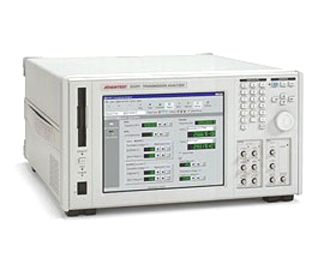

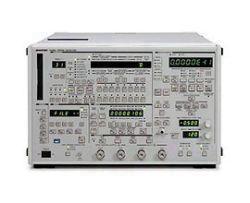
The Advantest D3371 Digital Transmission Analyzer operates across 10 MHz to 3.6 GHz and delivers precise characterization of digital communication systems through integrated pattern generation and error measurement. This instrument generates diverse test patterns—including PRBS, programmable, zero substitution, and STM frame patterns—at data rates up to 3.60 Gbps, supporting evaluation of Gigabit Ethernet and SONET/SDH links. The D3371 combines a pulse pattern generator with error measurement functions in a single platform, eliminating the need for separate test equipment.
– Technical Specifications
Signal Generation
• Frequency range: 10 MHz to 3.6 GHz
• Maximum data rate: 3.60 Gbps
• Pattern depth: 8 Mbit
• Output voltage: 2 Vp-p or 3 Vp-p (selectable via options)
• Output mode: NRZ, DC coupled
• Output paths: 2 (DATA and DATA)
• Synthesized clock generator: 10 MHz to 3.6 GHz
Clock Input Specifications
• Input amplitude: 0.5 to 2 Vp-p
• Input impedance: 50 Ω nominal
• Waveform: Rectangular wave (10 to 175 MHz); rectangular or sine wave (175 MHz to 3.6 GHz)
• Duty ratio: 50 ± 5%
• Connector: SMA female
Measurement Capabilities
• Error rate measurement
• Error count measurement
• Error interval measurement
• Error-free interval measurement
• Frequency measurement
• Error performance measurement
– Key Features
• 10.4-inch TFT LCD display with 800 × 600 resolution and touch panel control
• Windows 98 Second Edition operating system with 128 MB main memory
• 6 GB hard disk and 1.44 MB floppy disk storage
• Trigger modes: 1/8 clock, 1/32 clock, pattern phase, frames, and flexible
• GPIB (IEEE 488.2) and 10Base-T Ethernet remote control
• Parallel (D-sub 25) and USB (2 channels) connectivity
– Typical Applications
• Gigabit Ethernet testing and validation
• SONET/SDH system characterization
• Digital transmission link optimization
• Pattern generation for BER analysis
– Compatibility & Integration
The instrument supports remote operation via GPIB and Ethernet interfaces, enabling integration into automated test environments. Standard connectors—SMA, IEEE 488.2 bus, and D-sub 25—facilitate integration with existing laboratory systems.










Reviews
There are no reviews yet.