
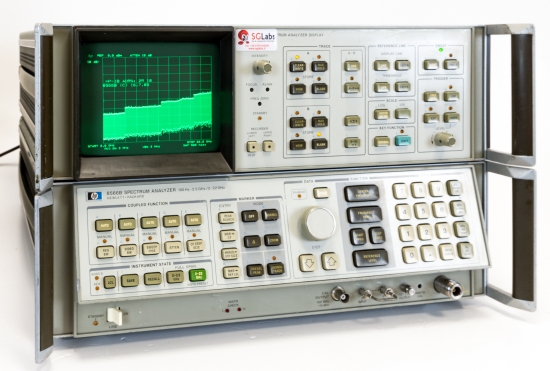

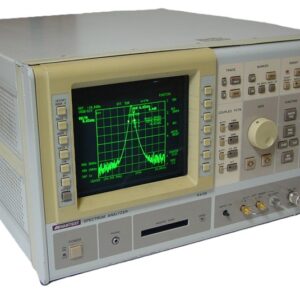
The Agilent/Keysight 8566B Spectrum Analyzer is a high-performance instrument designed for bench and ATE system use, offering a wide frequency range from 100 Hz to 22 GHz. It is engineered for superior measurement speed, microwave frequency accuracy, and sensitivity, enabling the analysis of low-level signals up to 22 GHz with narrow resolution bandwidths. The analyzer’s synthesizer stability effectively minimizes long-term drift and residual FM. Its capabilities can be extended to 325 GHz with external mixers, making it suitable for a broad spectrum of applications including telecommunications, aerospace, electronics manufacturing, EMC testing, and broadband signal surveillance. The instrument features an internal bus and microcomputer control, providing significant operating and data processing features, along with flexibility for computer control. It includes 16 KB of user RAM for storing trace data, instrument states, and custom downloadable programs (DLPs), and all displayed information can be sent to a plotter when the sweep time is 20 ms or greater.
### Technical Specifications
**Frequency Range:**
* 100 Hz to 22 GHz (dc-coupled input)
* Extendable to 325 GHz with external mixers
* Preselected external mixers extend coverage from 26.5 to 75 GHz
**Frequency Accuracy and Stability:**
* Frequency reference aging rate: < 1 x 10⁻⁹/day
* Frequency reference aging rate after 24-hour warm-up: < 1 x 10⁻⁸
* Frequency reference accuracy: < 2.5 x 10⁻⁷/year
* Temperature stability: < 7 x 10⁻⁹ over 0 °C to 55 °C range
* Center frequency readout accuracy:
* Spans ≤ n x 5 MHz: ± (2% of frequency span + frequency reference error x center frequency +10 Hz)
* Spans > n x 5 MHz: ± (2% of frequency span + n x 100 kHz + frequency reference error x center frequency)
* Zero span: ± (frequency reference error x center frequency)
* Frequency span readout accuracy:
* Spans ≤ n x 5 MHz: ±1% of indicated frequency separation
* Spans > n x 5 MHz: ±3% of indicated frequency separation
**Resolution Bandwidth (RBW):**
* 3 dB bandwidths: 10 Hz to 3 MHz in a 1, 3, 10 sequence
* Bandwidth selection: Manual or coupled to frequency span (AUTO mode)
* 3 dB bandwidth accuracy:
* 3 MHz: ±20%
* 3 kHz to 1 MHz: ±10%
* 10 Hz to 1 kHz: ±20%
* (30 kHz and 100 kHz bandwidth accuracy figures apply only with ≤ 90% relative humidity, 40 °C)
* 60 dB/3 dB bandwidth selectivity ratio:
* 100 kHz to 3 MHz: < 15:1
* 3 kHz to 30 kHz: < 13:1
* 30 Hz to 1 kHz: < 12:1
* (60 dB points on 10 Hz bandwidth are separated by < 100 Hz)
* Bandwidth shape: Synchronously tuned, approximately Gaussian
* Minimum Resolution Bandwidth: 10 Hz**Amplitude Measurement:**
* Amplitude measurement range: +30 dBm to -135 dBm
* Calibrated display: 90 dB
* Displayed values scale: 10 dB/division for 90 dB display from reference level
* Expanded scales: 5 dB/div (50 dB display), 2 dB/div (20 dB display), 1 dB/div (10 dB display)
* Linear scale: 10% of reference level/division
* Log digitization uncertainty:
* 10 dB/div: ±0.2 dB
* 5 dB/div: ±0.1 dB
* 2 dB/div: ±0.04 dB
* 1 dB/div: ±0.02 dB
* Linear digitization uncertainty: ±0.2% of reference level
* Error correction accuracy: ±0.4 dB (when SHIFT W and SHIFT X are executed)
* Absolute amplitude calibration uncertainty: ±2 dB over full 20 Hz to 22 GHz frequency range
* Gain compression: < 1.0 dB at 100 Hz to 22 GHz with < -5 dBm at input mixer**Displayed Average Noise Level (Sensitivity):**
* With 0 dB input attenuation and 10 Hz RBW:
* 100 Hz to 50 kHz: -135 dBm
* 50 kHz to 1 MHz: -134 dBm
* 1 MHz to 2.5 GHz: -134 dBm
* 2.0 to 5.8 GHz: -132 dBm
* 5.8 to 12.5 GHz: -125 dBm
* 12.5 to 18.6 GHz: -119 dBm
* 18.6 to 22 GHz: -114 dBm**Spurious and Harmonic Responses:**
* Harmonic and intermodulation distortion: > 70 dB below input signal
* Second harmonic distortion (for mixer levels < -40 dBm):
* 100 Hz to 50 MHz: < -70 dBc
* 50 to 700 MHz: < -80 dBc
* 700 MHz to 2.5 GHz: < -70 dBc
* Second harmonic distortion (for mixer levels ≤ -10 dBm, 2 to 22 GHz): < -100 dBc
* Third order intercept (TOI):
* 100 Hz to 5 MHz: > +5 dBm
* 5 MHz to 5.8 GHz: > +7 dBm
* 5.8 GHz to 18.6 GHz: > +5 dBm (typical)
* 18.6 to 22 GHz: > +5 dBm (typical)
* Third order intermodulation distortion (2 to 22 GHz, for > 100 MHz signal separation): > +50 dBm (typical)
* Noise sidebands (for frequency span < 25 kHz, except 100 kHz offset, and center frequency 100 Hz to 5.8 GHz):
* 320 Hz offset: -80 dBc/Hz
* 1 kHz offset: -85 dBc/Hz
* 10 kHz offset: -90 dBc/Hz
* 100 kHz offset: -105 dBc/Hz
* Power-line-related sidebands:
* Center frequency ≤ 100 MHz: -70 dBc
* Center frequency > 100 MHz to 5.8 GHz: -75 dBc
* Offset from carrier 360 kHz to 2 kHz: -75 dBc
* Offset from carrier > 2 kHz: -80 dBc
**Interfaces:**
* HP-IB (Hewlett-Packard Interface Bus)
**Physical Characteristics:**
* Dimensions: 626.4 x 457.2 x 279.2 mm (24.7 x 18 x 11 in)
* Weight: 50 kg (112 lbs)
**Power Requirements:**
* Line frequency: 50 to 60 Hz
* Voltage: 100, 120, 200, 220, or 240 V (+5%, -10%)
* Power consumption: Approximately 650 VA (40 VA in standby)
* Option 400: 400 Hz operation
**Environmental:**
* Operating Temperature: 0 °C to 55 °C
* Storage Temperature: -40 °C to 75 °C
**Internal Memory:**
* 16 KB of user RAM for storing trace data, instrument states, and custom downloadable programs (DLPs)
**Display:**
* CRT monochrome
**Other Features:**
* Internal bus and microcomputer control
* Synthesizer stability
* Up to four trace markers with amplitude and frequency readout
* Option 002: Turbo speed option for increased processing speed
* Compatible with EMI measurement software and accessories
* Calibrations traceable to NIST
Why Choose Aumictech for the Agilent/Keysight 8566B Spectrum Analyzer?
At Aumictech, we specialize in supplying high-performance RF and microwave test equipment. Whether you need precise signal analysis for telecommunications, aerospace, or demanding EMC compliance testing, our team ensures the Agilent/Keysight 8566B Spectrum Analyzer delivers maximum performance and reliability for your critical applications.








Reviews
There are no reviews yet.