


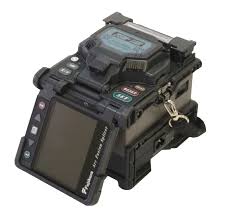
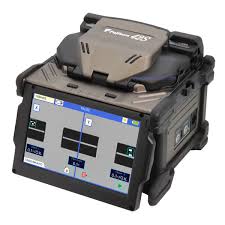
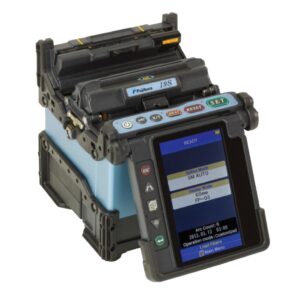
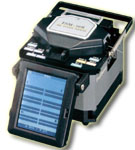
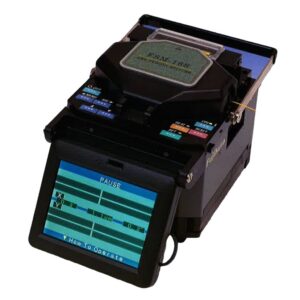
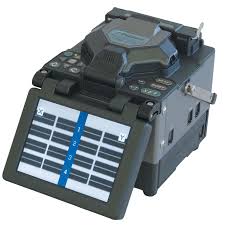
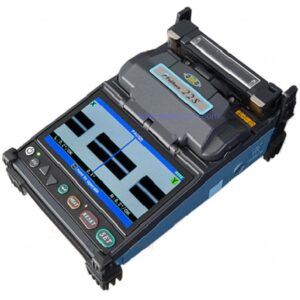
The Fujikura 62S is a core alignment fusion splicer for single-mode and multimode optical fibers. It employs Profile Alignment System (PAS) technology with dual-axis CMOS camera observation to deliver automatic core-to-core alignment, consistent low splice loss, and accurate loss estimation across fiber types. Field and laboratory deployments benefit from real-time arc calibration, programmable splice and heating modes, and heritage-proven electrode performance.
## Technical Specifications
**Fiber Compatibility**
• Single Mode: ITU-T G.652, G.657
• Multimode: ITU-T G.651
• Dispersion Shifted: ITU-T G.653
• Non-Zero Dispersion Shifted: ITU-T G.655
• Cladding diameter: 80–150 µm
• Sheath diameter: 100–3000 µm
**Splice Loss Performance**
• Single Mode: 0.02 dB typical
• Multimode: 0.01 dB typical
• Dispersion Shifted: 0.04 dB typical
• Non-Zero Dispersion Shifted: 0.04 dB typical
• Return Loss: >>60 dB
**Alignment & Observation**
• Dual-axis CMOS camera system at 320X magnification (400X post-splice)
• Core-to-core alignment for SM/DS/NZDS fibers
• Cladding-to-cladding alignment for MM fiber
• Real-time arc calibration with cladding illumination feedback
• 4.73″ color LCD display
**Splice Modes & Timing**
• 100 preset and user-programmable splice modes
• Ultra Fast mode: 6 sec
• SM Fast mode: 7 sec
• SM Auto mode: 10 sec
• Tube heating: 15–25 sec depending on sleeve type and coating diameter
**Data Storage & Electrodes**
• Stores last 10,000–15,000 splices
• Electrode life: 3,000 arc-discharges per pair; 5,000 splices
• Spare electrodes: ELCT2-20A
**Cleave & Tension**
• Cleave length: 5–16 mm with sheath clamp
• Tension test load: 1.96–2.25 N (200–230 gf)
## Key Features
• Attenuation splice function: 0.1–15 dB in 0.1 dB steps for in-line fixed attenuators
• Splice loss estimation accounting for core deformations and axis offsets
• Manual and automatic arc power calibration
• 30 preset and user-programmable heating modes
• AC100–240V, 50–60 Hz or DC10–12V operation
## Typical Applications
Network installation and maintenance, cable plant splicing, lab characterization, and field repairs where low-loss, high-return-loss joints are required across heterogeneous fiber types.









Reviews
There are no reviews yet.