
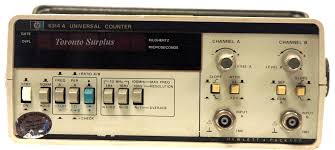

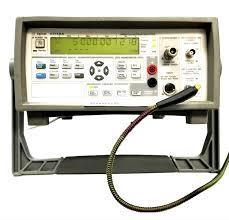
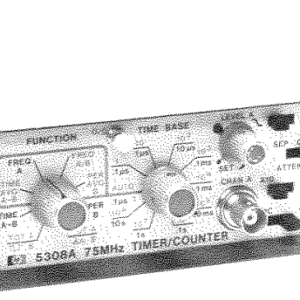
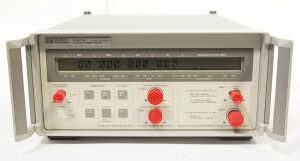
The HP/Agilent 5314A is a basic universal counter engineered for frequency, period, time interval, and ratio measurements across electronics testing, service, and educational laboratories. With a 7-digit LED display and measurement capability to 100 MHz, it delivers reliable performance through selectable triggering controls, adjustable slope and trigger level, and front-panel simplicity suited to both field technicians and training environments.
## Technical Specifications
**Measurement Functions**
• Frequency (10 Hz to 10 MHz direct; 1 MHz to 100 MHz prescaled by 10)
• Single-shot and averaged period (10 Hz to 2.5 MHz)
• Time interval (250 ns to 1 second)
• Frequency ratio A to B
• Totalize
• Self-check
**Frequency Measurement**
Resolution down to ± LSD with accuracy of ± LSD ± (time base error) × Frequency. Selectable least significant digits: 0.1 Hz, 1 Hz, or 10 Hz in direct count mode; 10 Hz, 100 Hz, or 1 kHz in prescaled mode.
**Period & Time Interval**
Period measurements from 10 Hz to 2.5 MHz with 100 ns LSD. Time interval measurements spanning 250 ns to 1 second with 100 ns resolution. Both support decade-step averaging from N=1 to 1000.
**Input Specifications**
AC coupling through 1 MΩ nominal impedance (shunted <30 pF). Channel A sensitivity: 25 mV rms to 100 MHz; 75 mV peak-to-peak minimum at 5 ns pulse width. Channel B sensitivity: 25 mV rms to 2.5 MHz; 75 mV peak-to-peak at 200 ns minimum pulse width. Dynamic range: 75 mV to 4 V peak-to-peak. Selectable X1 or X20 attenuator on Channel A. Trigger level continuously variable ± 350 mV (multiplied by attenuator setting) with independent slope selection (positive or negative).
**Time Base**
10 MHz frequency with aging rate <3 parts per 10⁶ per month. Temperature stability ± 10 parts per 10⁶ over 0 to 50 °C.
## Key Features
• 7-digit LED display with overflow indication
• Separate or common channel input selectable
• Ratio measurement to 1 part in 10ⁿ resolution
• Intuitive front-panel controls requiring minimal training
## Typical Applications
Frequency verification, period analysis, timing characterization, signal ratio comparison, component testing, and educational demonstrations in electronics laboratories.







Reviews
There are no reviews yet.