


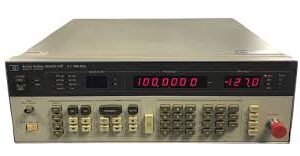
The Aeroflex CS25020F is a precision RF signal generator delivering broadband signal generation and environmental simulation up to 18.00 GHz. Built on a software-defined architecture, this benchtop instrument combines real-time waveform synthesis with playback of recorded signals, enabling complex multi-domain testing in telecommunications, satellite communications, radar, and research environments. Engineers can import custom waveforms, apply realistic impairments, and execute rapid frequency transitions at rates up to 500,000 hops per second.
– Technical Specifications
• Maximum Frequency: 18.00 GHz
• Frequency Resolution: 1.0 Hz
• Instantaneous Bandwidth: 60 MHz
• SFDR (Spurious-Free Dynamic Range): 58 dB typical
• Output Impedance: 50 Ohm
• Signal Memory: Up to 88 seconds of full bandwidth storage on solid-state memory; extended playback to 150 minutes via streaming RAID configuration
• Frequency Hop Rate: Up to 500,000 hops per second
– Key Features
• Modulation support: AM, FM, Pulse, Phase, FSK, I/Q, ASK, MSK, PSK, QAM
• Open waveform architecture for user-created signal import
• Real signal playback from Aeroflex Broadband Signal Analyzers or external recorded sources
• Signal impairment injection: thermal noise, phase noise, passband amplitude and phase distortion
• Vector Signal Simulator (VSS) software integration for commercial wireless standards and generic signal generation (nPSK, nQAM, nFSK, MSK, CW, tone combs, notched noise)
– Typical Applications
• Telecommunications system validation
• Satellite communications testing
• Radar signal simulation and analysis
• Advanced research and development
– Compatibility & Integration
The CS25020F operates as a Broadband Signal and Environment Generator (BSG) with standard RF output connectors and supports software-defined control. Signal playback capability enables combination of recorded real-world signals with digitally generated test vectors, expanding test coverage beyond purely synthetic stimulus.












Reviews
There are no reviews yet.