


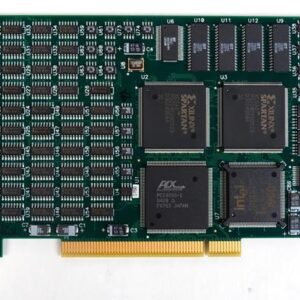
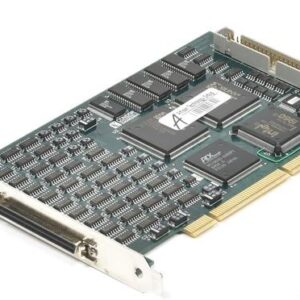
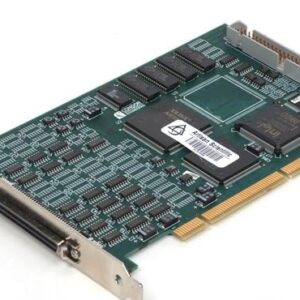
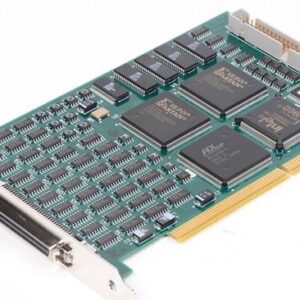
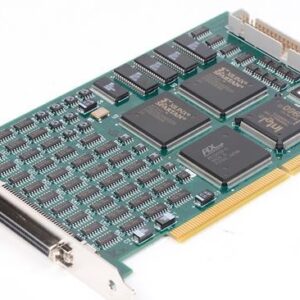
The Abaco Systems PCIE-5565PIORC-200A00 is a low-profile PCI Express Reflective Memory (RFM) node interface card that enables deterministic, software-transparent data sharing across up to 256 independent nodes. Data written to one node’s memory automatically mirrors to all other nodes on the network via fiber-optic links, supporting transfer rates from 43 Mbyte/s (4-byte packets) to 170 Mbyte/s (64-byte packets) in non-redundant mode. Redundant transfer mode delivers 20 Mbyte/s to 87 Mbyte/s with enhanced error suppression. The card integrates x4 Lane PCI Express 1.0a connectivity with one independent DMA channel, field-upgradeable firmware, and configurable 128 Mbyte or 256 Mbyte onboard SDRAM.
– Technical Specifications
• Form Factor: Low-profile PCI Express
• PCI Interface: x4 Lane PCI Express 1.0a to PCI Bridge
• PCI Express Signaling: 2.5 GHz
• DMA Channels: One independent channel
• Onboard SDRAM: 128 Mbyte or 256 Mbyte (configurable)
• Packet Size: 4 to 64 bytes (dynamic)
• Fiber Optic Network Speed: 2.12 Gbaud serially
• Data Transfer Rate (Non-Redundant): 43 Mbyte/s to 170 Mbyte/s
• Data Transfer Rate (Redundant): 20 Mbyte/s to 87 Mbyte/s
• Maximum Nodes: 256
• Dimensions: 6.6 inches × 2.713 inches
• Weight: 0.2 lbs
• Operating Temperature: 0°C to +65°C (with forced air cooling)
• Cooling: 300 LFM
• Compliance: RoHS
– Key Features
• Multimode fiber support up to 300 meters; single-mode fiber to 10 kilometers
• Any node can generate interrupts to any other node or all nodes with a single command.
• Error detection with redundant transfer mode option.
• Field-upgradeable firmware.
• Software transparent operation minimizes host processor overhead.
– Typical Applications
• Aircraft simulators
• Ship and submarine simulators
• Industrial control systems
• Automated testing systems
• Power plant simulators
• Engine test facilities
• Aluminum rolling mills
– Compatibility & Integration
Supports Linux, VxWorks, and Windows. Bus structure independence allows integration of diverse hardware platforms and operating systems into a single shared-memory network.









Reviews
There are no reviews yet.