
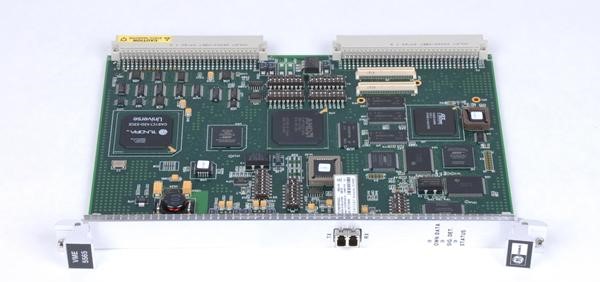

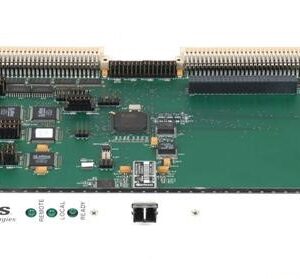
The Abaco Systems VMIVME-5565-110000 is a Reflective Memory Node Card for VMEbus systems that enables deterministic, real-time data sharing across distributed processor networks using optical ring-based shared memory technology. Independent of bus structures and operating systems, this card delivers high-speed, software-transparent data transfer with minimal latency—ideal for simulations, industrial control, and advanced data acquisition where timing precision and data consistency are critical.
– Technical Specifications
Data Transfer Performance
• Network data rate: up to 170 Mbyte/s sustained
• VMEbus transfer rate: up to 40 Mbyte/s
• Serial connection speed: 2.12 Gbaud
• Nonredundant mode: 43 Mbyte/s (single longword) to 174 Mbyte/s (64 byte bursts)
• Redundant mode: 20 Mbyte/s (single longword) to 87 Mbyte/s (64 byte bursts)
• Deterministic latency: approximately 450 to 500 nanoseconds between nodes
Network Architecture
• Supports up to 256 independent nodes
• Dynamic packet sizes: 4 to 64 bytes
• Onboard SDRAM: 64 Mbyte or 128 Mbyte (configurable)
• Fiber-optic network interface with multimode (up to 300 m) and single mode (up to 10 km) support
• Small form factor (SFF) LC connectors
System Integration
• VMEbus 6U Eurocard form factor
• VMEbus compliance: ANSI/IEEE STD 1014-1987, IEC 821 and 297
• Address mnemonics: A32:A24:D32/D16/D08 (EO); Slave: 39/3D:09/0D
• Error detection and management
• Interrupt capability: any node can generate interrupts to any other node or all network nodes
– Key Features
• Software-transparent data transfer—zero processor overhead
• Optical ring topology isolates data path from VMEbus contention
• Deterministic timing independent of operating system or bus load
• Redundant and nonredundant operation modes
• RoHS compliant
– Environmental Specifications
• Operating temperature: 0 to +65 °C (with forced air cooling)
• Storage temperature: -40 to +85 °C
• Relative humidity: 20% to 80%, non-condensing
– Typical Applications
Real-time simulations, deterministic industrial control systems, distributed data acquisition networks, and multi-processor architectures requiring guaranteed latency and consistent data synchronization across nodes.







Reviews
There are no reviews yet.