
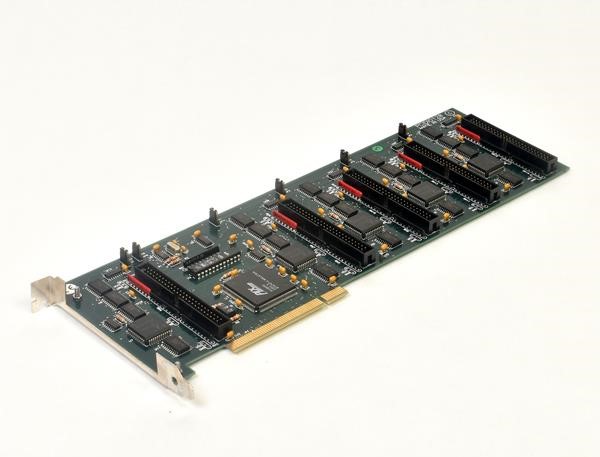

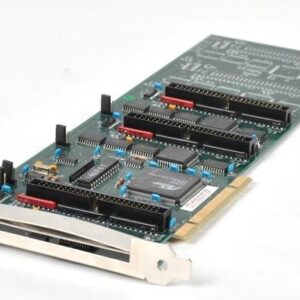
The Acces PCI-DIO-120 is a digital input/output card for PCI bus systems, delivering up to 120 channels of configurable digital I/O. Built on FPGA technology that emulates 8255-compatible chips, it provides flexible, software-controlled port configuration for industrial automation, data acquisition, and control applications. Each I/O line is buffered and individually manageable through tri-stateable outputs and jumper-configurable pull-up/pull-down resistors.
– Technical Specifications
Digital I/O Channels
• Up to 120 channels of digital I/O (also available in 72-bit and 96-bit configurations)
• Three 8-bit ports (A, B, C) with independent input/output configuration
• Port C subdivides into two 4-bit nybbles via software
Interface & Electrical
• PCI bus (Universal PCI, PCI-X compatible)
• 3.3V and 5V logic compatible
• Global jumper-selectable VCCIO: 5V, 3.3V, 2.5V, or 1.8V
• Output current: 32 mA sourcing or 64 mA sinking at 5V VCCIO
• 10 kΩ pull-up resistors to +5VDC (jumper-configurable to pull-down)
• Jumper-selectable pull-up/pull-down resistors per four- and eight-bit ports
• Interrupt generation capability from Port C bit 3
Power & Connectivity
• VCCIO and +5V supply available to user via 50-pin connectors
• 0.5A resettable fuse per 50-pin connector
• Physical length: 12.2 inches (310 mm) with 4.2 inches seated height
– Key Features
• Buffered I/O lines with global tri-stateable control
• Flexible port configuration supporting input, output, or mixed modes
• Port C configurable as four inputs with four output latches
• Compatible with industry-standard I/O racks (Grayhill, Opto 22, Western Reserve Controls, Gordos, Potter & Brumfield)
• Windows auto-detection (95/98/NT and later)
– Typical Applications
Industrial automation, sensor interfacing, relay control, data acquisition systems, and device control requiring multi-channel digital I/O.
– Compatibility & Integration
Supported on DOS, Linux, macOS, Windows XP through Windows 10 (32-bit and 64-bit), Windows XPe, WES7, and vxWorks. Includes sample programs and source code in Visual Basic, Delphi, and Visual C++ for Windows. Linux support includes kernel driver installation files and user-level programming samples.










Reviews
There are no reviews yet.