
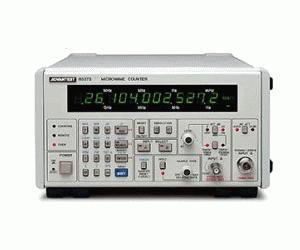

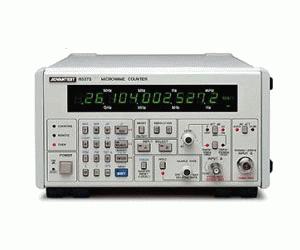
The Advantest R5372 is a microwave frequency counter engineered for precise frequency measurements across the microwave spectrum. It employs Advantest’s proprietary digital TRAHET system—combining transfer oscillator and heterodyne techniques—to deliver 1 Hz resolution at microwave frequencies while supporting pulse-modulated signal analysis. The instrument combines reciprocal counting for low-frequency precision with advanced heterodyne architecture for high-frequency accuracy, making it suitable for satellite communications, radar systems, and broadcast applications.
– Technical Specifications
Frequency Measurement Range:
• Input A: 10 mHz to 10 MHz (DC coupling); 10 Hz to 10 MHz (AC coupling)
• Input B: 500 MHz to 18 GHz
• Frequency resolution: 1 Hz in 1 second; user-selectable in decades from 0.1 Hz to 10 MHz
Pulse-Modulated Carrier Measurement:
• Frequency range: 500 MHz to 18 GHz (Input B)
• Pulse width range: 100 ns to 0.1 s (internal sync); 50 ns to 0.1 s (external sync); minimum 0.5 µs
• Pulse width resolution: 10 ns
• Pulse repetition frequency: 10 Hz to 5 MHz
• FM tolerance: ±25 MHz (500 MHz–1.4 GHz manual); ±125 MHz or more (≥1.4 GHz manual); 10 MHz p-p (automatic, worst case)
Input Specifications:
• Channel 1: 10 Hz to 550 MHz, 25 mV sensitivity, 5 V maximum input, 50 Ω impedance, AC coupling, x1/x20 attenuation
• Channel 2: 500 MHz to 18 GHz, 2.24 V sensitivity
• Maximum input: -20 dBm (500 MHz–18 GHz); +10 dBm (ATT AUTO); +20 dBm (ATT 20 dB)
Time Base Stability:
• Standard: 1 × 10⁻⁷/yr (long-term); ±5 × 10⁻⁸ (temperature)
• Option 21: 5 × 10⁻⁹/day; ±5 × 10⁻⁸ (temperature)
• Option 22: 2 × 10⁻⁹/day; ±1 × 10⁻⁸ (temperature)
• Option 23: 5 × 10⁻¹⁰/day; ±5 × 10⁻⁹ (temperature)
• Time base output: 10 MHz, 1 Vp-p minimum, ~50 Ω impedance
• External standard input: 1, 2, 2.5, 5, or 10 MHz; 1–10 Vp-p; ~500 Ω impedance
– Key Features
• Dual-channel architecture supports simultaneous low and microwave frequency measurements
• Digital TRAHET system enables high-resolution microwave analysis without external converters
• Pulse-width measurement with 10 ns resolution for radar and communications testing
• Selectable external frequency standards for traceability
• Attenuation options optimize signal conditioning across wide dynamic range
– Typical Applications
• Satellite communication frequency verification
• Radar system carrier and modulation analysis
• Broadcast transmitter frequency stability monitoring
• Pulsed microwave signal characterization
– Compatibility & Integration
External frequency standard input accepts standard 10 MHz references via BNC connector, enabling integration with atomic clocks and frequency standards. Time base output provides 10 MHz reference for downstream instrumentation.










Reviews
There are no reviews yet.