
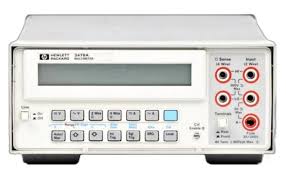

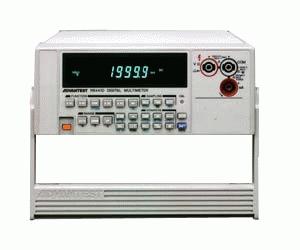
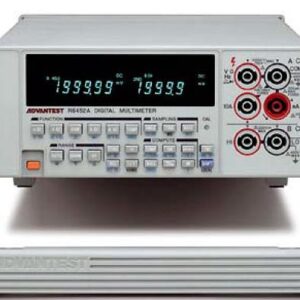
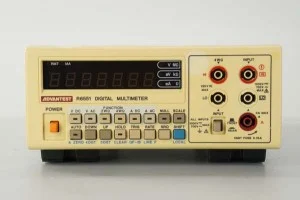
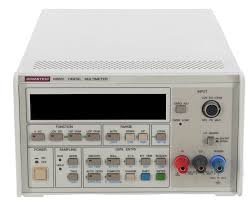
The Agilent/HP 3478A is a benchtop digital multimeter delivering precision measurements across DC/AC voltage, current, resistance, frequency, and diode test functions. Its 5½-digit LCD display and selectable measurement speeds (1, 10, or 100 readings/sec) support both high-resolution analysis and rapid troubleshooting in laboratory and field environments. GPIB (IEEE-488) connectivity enables automated test sequences and data logging for calibration workflows and production testing.
– Technical Specifications
DC Voltage: Five ranges from 100 mV to 1000 V with ±(0.02% reading + 0.01% range) accuracy; 10 MΩ input impedance; CMRR >120 dB at DC and 60 Hz.
AC Voltage (True RMS): Four ranges, 1 V to 1000 V; 45 Hz to 50 kHz frequency response; ±(0.3% reading + 0.1% range) accuracy; 1 MΩ ±5% input impedance with <100 pF parallel capacitance; 3:1 crest factor at full scale.
DC Current: Four ranges, 10 mA to 10 A; ±(0.15% reading + 0.05% range) accuracy; <0.3 V shunt drop.
AC Current (True RMS): Two ranges, 1 A and 10 A; 45 Hz to 5 kHz bandwidth; ±(0.75% reading + 0.1% range) accuracy.
Resistance (2-Wire/4-Wire Kelvin): Five ranges spanning 100 Ω to 10 MΩ; ±(0.05% reading + 0.01% range) on 100 Ω–100 kΩ ranges; selectable test currents from 0.1 µA to 1 mA; ~4 V open-circuit voltage.
Frequency: 10 Hz to 100 kHz range with ±(0.01% reading + 1 digit) accuracy.
Diode Test: ~1 mA test current; ~3.5 V voltage compliance.
Continuity: Audible beep below ~20 Ω.
– Key Features
• 5½-digit display with unit and function annunciators
• True RMS AC measurements (voltage and current)
• Selectable measurement speeds for resolution/throughput trade-offs
• 4-wire Kelvin resistance for low-ohm precision
• Frequency counter integrated into AC measurement paths
– Typical Applications
• Bench calibration and verification
• In-circuit component characterization
• Power supply and amplifier testing
• Device troubleshooting in development and field service
– Compatibility & Integration
GPIB (IEEE-488) interface for controller integration and automated measurement sequences.




Reviews
There are no reviews yet.