


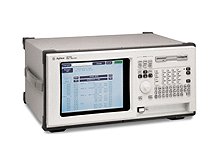
The Agilent/Keysight 1653B is a logic analyzer combining oscilloscope and state/timing analysis in a single instrument for digital system debugging and verification. It delivers two simultaneous 400 MSa/s analog channels with 100 MHz bandwidth and 2,048 samples per channel, plus 80/32 channels of logic analysis. Time-correlated state, timing, and oscilloscope displays appear on one screen, enabling engineers to observe hardware and software interactions with sub-nanosecond timing resolution. The instrument captures non-repeating events and glitches with accuracy better than 1 ns, supports asynchronous pattern triggering with duration specifications, and includes deep memory for extended captures at high sample rates.
– Technical Specifications
Oscilloscope Channels
• Two simultaneous 400 MSa/s digitizing channels
• 100 MHz bandwidth per channel
• 2,048 samples per channel
• Precision voltage and time interval measurements, autoscale, waveform math, auto-calibration, infinite persistence, and averaging display modes
Logic Analysis
• 80/32 channels for state and timing analysis
• Deep memory architecture for long-duration captures
• Timing waveform display: 10 ns/div to 100 s/div with 0.01% resolution
• Hardware delay: 20 ns to 10 ms
• Maximum 24 displayed waveform lines
• Accumulate and overlay display modes
Timing Accuracy
• Sample period accuracy: 0.01% of sample period
• Channel-to-channel skew: 4 ns typical
• Time interval accuracy: ± (sample period + channel-to-channel skew + 0.01% of time interval reading)
• Trigger accuracy: +20 ns to -0 ns
Trigger Capabilities
• Asynchronous pattern triggering on patterns with duration specifications
• Greater than duration: 40 ns to 10 ms with 10 ns or 0.01% resolution
• Pattern validity minimum: 20 ns
Input Characteristics
• Minimum input voltage swing: 600 mV peak-to-peak
• Input threshold accuracy: ±150 mV over -2.0 to 2.0 V; ±300 mV over -9.9 to -2.1 V and 2.1 to 9.9 V
• Input dynamic range: ±10 V about threshold
• Minimum input overdrive: 250 mV or 30% of input amplitude
– Key Features
• Pattern definition via logical AND of low, high, or don’t-care states per channel
• Non-repeating event capture with glitch detection
• Built-in disk drives
• Support for popular processors and bus interfaces
– Typical Applications
• Real-time digital system characterization and timing parameter validation
• Microprocessor and embedded system debugging
• Bus protocol analysis and verification
– Compatibility & Integration
Supports popular processors and bus interfaces for direct integration into development environments.







Reviews
There are no reviews yet.