


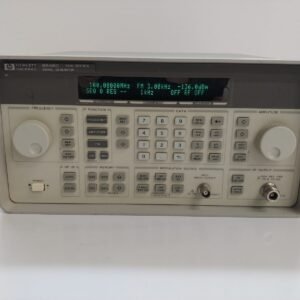
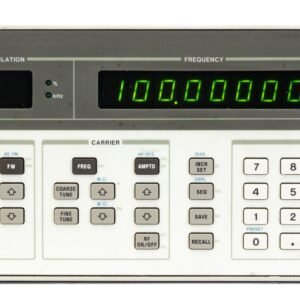
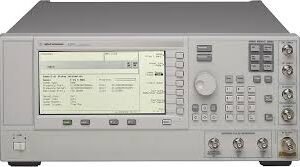
The Agilent/Keysight N5183A MXG is a microwave analog signal generator delivering precision RF synthesis across multiple frequency bands. It combines fast frequency switching, low phase noise, and flexible modulation to support calibration, metrology, and device characterization from 100 kHz to 40 GHz.
– Technical Specifications
Frequency Performance
• Frequency range: 100 kHz to 20 GHz (Option 520), 100 kHz to 31.8 GHz (Option 532), or 100 kHz to 40 GHz (Option 540)
• Frequency resolution: 0.01 Hz
• Frequency switching speed: ≤900 µs (≤600 µs typical)
• Fast switching available via Option UNZ
Output Power
• Maximum output power: +18 dBm at 20 GHz; +19 dBm typical
• Power range at 1 GHz: –130 dBm to +18 dBm
• High power option available (Option 1EA)
• Leveling modes: Internal, external detector, ALC off, search
• SWR: 1.6:1 typical from 100 kHz to 20 GHz
Spectral Purity
• Phase noise: ≤–116 dBc/Hz at 20 kHz offset (typical); –107 dBc/Hz typical at 20 kHz offset from 3 GHz carrier
• Non-harmonic spurious: ≤70 dBc at 1 GHz
Modulation
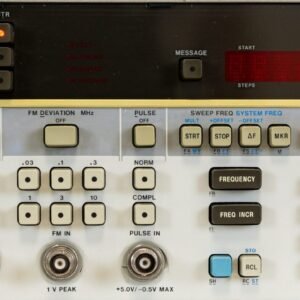
• AM, FM, phase modulation, and pulse modulation
• FM maximum deviation: 10 MHz at 1 GHz
• FM modulation rate: DC to 7 MHz at 100 kHz deviation
• Phase modulation deviation: 1.25 rad to 160 rad
• Pulse characteristics: <10 ns rise/fall time, 20 ns pulse widths
• Simultaneous modulation supported (FM and phase modulation excluded)
• Modulation options: Analog (Option UNT), pulse (Option UNU), narrow pulse (Option UNW), pulse train generator (Option 320)
• Sweep modes: Digital and step
Thermal Stability
• Level accuracy within ±tolerance from –20 dBm to maximum output power at 15–35 °C
• Temperature coefficient: 0.01 dB/°C (typical) outside 20–30 °C
• Frequency-dependent drift above 4.5 GHz
– Key Features
• Multiple frequency options to 40 GHz
• Sub-microsecond frequency switching
• Wide dynamic range: –130 dBm to +18 dBm
• Low phase noise suitable for sensitive receiver testing
• Internal and external leveling control
• Pulse modulation with <10 ns edge rates
– Typical Applications
• Component and subsystem characterization
• Receiver sensitivity measurement
• Phase noise analysis
• Pulse-modulated system testing
• Frequency conversion verification
– Compatibility & Integration
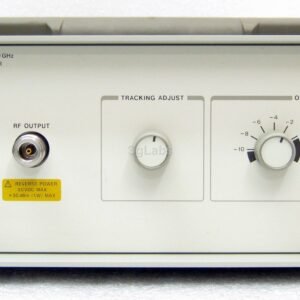
Connector options include standard waveguide transitions and Type-N connectors (Option 1ED). External power meter integration via detector leveling enables closed-loop amplitude control.





Reviews
There are no reviews yet.