
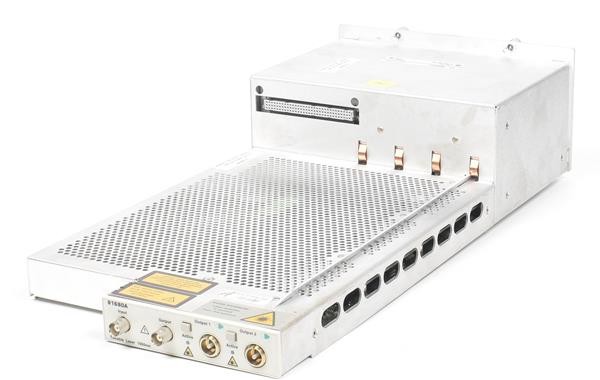

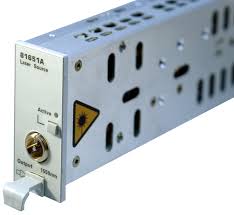
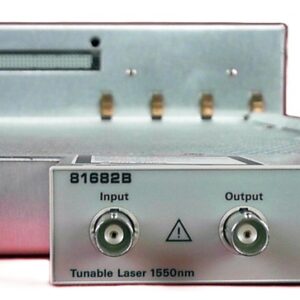
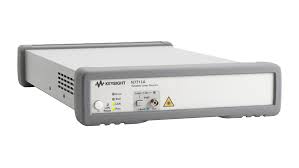
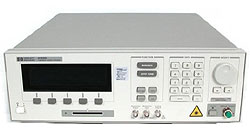
The Agilent/Keysight 81680A is a tunable laser module delivering precise wavelength control across the C-band with mode-hop-free tuning and dual output ports optimized for distinct measurement scenarios. The instrument combines ultra-low source spontaneous emission on Output 1 with high-power capability on Output 2, making it essential for characterizing DWDM devices, optical amplifiers, and integrated photonic circuits. Polarization-maintaining fiber output preserves state of polarization for waveguide measurements requiring polarization stability.
– Technical Specifications
• Wavelength Range: 1460 nm to 1580 nm
• Wavelength Resolution: 0.1 pm (12.5 MHz at 1550 nm)
• Mode-Hop-Free Tuning: Full wavelength range
• Absolute Wavelength Accuracy: ±0.01 nm
• Relative Wavelength Accuracy: ±5 pm typical; ±2 pm
• Wavelength Repeatability: ±1 pm typical; ±0.5 pm
• Wavelength Stability: ≤ ±1 pm typical over 24 hours at constant temperature
• Tuning Speed: 400 ms (1 nm) / 600 ms (10 nm) / 2.8 s (100 nm)
• Linewidth (Coherence Control Off): 100 kHz typical
• Effective Linewidth (Coherence Control On): > 50 MHz typical (1480–1580 nm)
• Output 1 Power (Low SSE): -4 dBm peak typical; -6 dBm (1520–1570 nm); -10 dBm (1480–1580 nm); -13 dBm minimum (1460–1580 nm)
• Output 2 Power (High Power): 6 dBm peak typical; 5 dBm (1520–1570 nm); 1 dBm (1480–1580 nm); -3 dBm minimum (1460–1580 nm)
• Power Stability: ±0.01 dB (1 hour); ±0.03 dB (24 hours) typical
• Power Repeatability: ±0.01 dB typical
• Power Linearity: ±0.1 dB
• Power Flatness vs. Wavelength: ±0.2 dB typical
• Side-Mode Suppression Ratio: ≥ 40 dBc typical
• Signal-to-Source Spontaneous Emission: ≥ 63 dB/nm typical (1520–1570 nm)
• Relative Intensity Noise: > 58 dB/nm² typical (1480–1580 nm)
• Return Loss: 40 dB typical (options 021, 071)
– Key Features
• Dual optical outputs with independent power control
• Panda polarization-maintaining fiber with selectable connector types
• Wavelength repeatability ±0.5 pm enables fast wavelength-dependent component screening
• Coherence control mode extends effective linewidth for reduced coherent crosstalk effects
– Typical Applications
• DWDM component characterization and alignment
• Optical amplifier gain and noise figure measurement
• Integrated photonic circuit testing
• Polarization-sensitive device evaluation
– Compatibility & Integration
• Operating temperature: +10°C to +35°C
• Storage temperature: -40°C
• Laser Classification: Class IIIb (FDA 21 CFR 1040.10); Class 3A (IEC 825-1:1993)







Reviews
There are no reviews yet.