


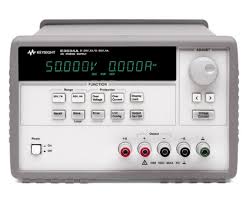
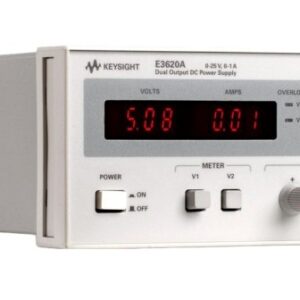
The Keysight E3646A is a 60 W dual-output, dual-range programmable DC power supply engineered for R&D, design verification, and production testing. Each output independently selects between 0–8 Vdc @ 0–3 A or 0–20 Vdc @ 0–1.5 A, with voltage programming accuracy of ±0.05% + 10 mV and load regulation under 0.01% + 3 mV. Output voltage ripple remains below 0.5 mVrms / 5 mVpp, while transient response recovers within 50 µsec following load step changes. Readback accuracy for voltage is ±0.05% + 2 counts; current readback is ±0.15% + 5 mA on Output 1 and ±0.15% + 10 mA on Output 2.
– Technical Specifications
• Output Power: 60 W total
• Dual-Range Outputs: 0–8 Vdc @ 0–3 A or 0–20 Vdc @ 0–1.5 A per output
• Voltage Programming Accuracy: ±0.05% + 10 mV
• Load Regulation (Voltage): < 0.01% + 3 mV
• Load Regulation (Current): < 0.01% + 250 µA
• Voltage Ripple & Noise: < 0.5 mVrms / < 5 mVpp
• Current Noise: < 4 mArms
• Transient Response: < 50 µsec (full to half load, within 15 mV)
• Voltage Readback Accuracy: ±0.05% + 2 counts
• Current Readback Accuracy: ±0.15% + 5 mA (Output 1); ±0.15% + 10 mA (Output 2)
• Stability (8 hours, constant load/temperature): Voltage < 0.02% + 2 mV; Current < 0.02% + 3 mA
• Over-Voltage Protection Accuracy: ±(0.5% + 0.5 V)
• OVP Activation Time: < 1.5 msec (≥ 3 V); < 10 msec (< 3 V)
• AC Input: 115 Vac ±10%, 47–63 Hz (standard); options for 100 Vac or 230 Vac
• Maximum Input Power: 210 VA
• Common Mode Current: < 1.5 µArms
– Key Features
• Front and rear output terminals for flexible test-point connectivity
• Remote sensing capability with 1 V maximum load lead voltage drop
• Vacuum fluorescent display with front-panel rotary knob and keypads
• Dual-range selectable outputs on each channel
• Programmable over-voltage protection with adjustable trip threshold
• Fan-cooled with automatic speed control for reduced noise
• Safety Class I with protective earth terminal
• User-replaceable power line fuse
– Interfaces & Control
• GPIB (IEEE-488) — standard
• RS-232 — standard
• SCPI (Standard Commands for Programmable Instruments) compatible
– Typical Applications
• Component and subsystem design verification
• Automated production test systems
• Research and development bench work
• Sensitivity and margin testing of electronic circuits






Reviews
There are no reviews yet.