


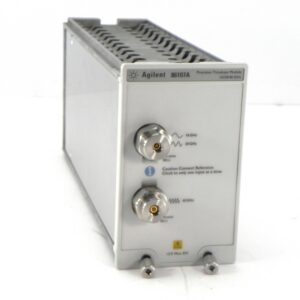
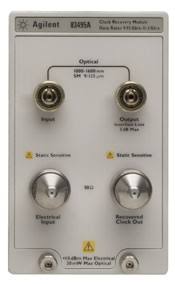
The Keysight N1076A Electrical Clock Recovery is a precision module that locks onto high-speed serial data signals and outputs a clean, recovered clock for signal integrity analysis. Integrated into Keysight’s DCA platform oscilloscopes, it delivers standards-compliant clock recovery across NRZ and PAM4 signaling from 50 MBaud to 32 GBaud. The module employs a “Golden PLL” with adjustable loop bandwidth up to 20 MHz and peaking, enabling jitter analysis and eye diagram characterization even from closed-eye signals when paired with equalizers. Its residual random jitter measures below 100 fs RMS, making it essential for compliance testing across PCIe, Ethernet, and high-speed serial protocols.
– Technical Specifications
• Data Rate Range: 50 MBaud to 32 GBaud continuous
• Signal Types: NRZ and PAM4 electrical signals
• Recovered Clock Output Frequency: 50 MHz to 16 GHz
• Auxiliary Output Frequency: 4 GHz to 8 GHz
• Input Level to Acquire Lock: Single-ended 25 mVpp; Differential 50 mVpp
• Input Voltage Levels: −2.2 V to 3.2 V maximum; ±500 mV maximum; ±2.2 Vpp maximum
• Phase-Locked Loop Residual Jitter: <100 fs RMS
• PLL Loop Bandwidth: Adjustable up to 20 MHz with peaking
– Key Features
• Standards-compliant "Golden PLL" clock recovery with adjustable bandwidth and peaking
• Jitter Spectrum Analysis (JSA) option for root cause identification
• Acquisition from severely degraded signals using optional external or integrated equalizers
• Low residual random jitter performance for precision timing applications
• Single-ended and differential data input configuration
– Typical Applications
• PCIe and Ethernet compliance testing
• Jitter characterization and eye diagram analysis
• High-speed serial protocol signal integrity verification
• Clock recovery from noise-degraded data streams
– Compatibility & Integration
The N1076A is a DCA-M module that integrates with N1000A, N1090A, N1092-series, and N1094-series Keysight DCA-M oscilloscopes, or operates via USB connection to N1010A FlexDCA software on a standalone PC. Data inputs (single-ended and differential) connect through splitters to the module and oscilloscope channels; recovered clock output drives the oscilloscope's clock or trigger input.









Reviews
There are no reviews yet.