


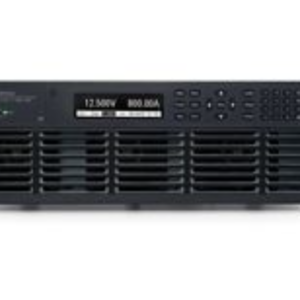
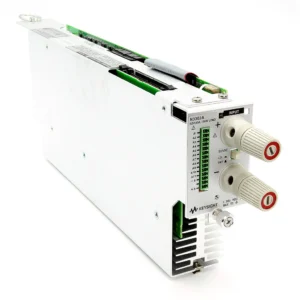
The Keysight RP7952A is a bidirectional regenerative power system delivering 10 kW across 0–500 V and ±40 A output. Operating in two-quadrant mode, it functions simultaneously as a DC power source and electronic load, enabling uninterrupted transitions between sourcing and sinking current. The regenerative design returns up to 90% of consumed energy to the grid, reducing cooling and operational costs. Three-phase AC input (200–208 VAC, ±10%) draws 35 A per phase at 0.99 power factor with efficiency exceeding 80% at full power. Output autoranging expands the voltage-current operating envelope. Voltage regulation holds within 30 mV load change; current regulation within 17 mA. Transient response recovers in 500 μs with 1.25 V settling band. Output ripple measures 100 mV RMS and 500 mV peak-to-peak. The compact 3U-high form factor (31.8 kg) integrates into standard racks.
– Technical Specifications
• Output Voltage: 0–500 V
• Output Current (Source/Sink): 0–±40 A
• Maximum Power: 10 kW
• AC Input: 200–208 VAC, ±10%, 3-phase
• Input Current per Phase: 35 A @ 200 VAC
• Power Factor: 0.99
• Efficiency: ≥80% at full power
• Voltage Ripple & Noise: 100 mV RMS / 500 mV peak-to-peak
• Load Regulation (Voltage): 30 mV
• Load Regulation (Current): 17 mA
• Voltage Programming Accuracy: 0.03% + 60 mV
• Voltage Measurement Accuracy: 0.03% + 80 mV
• Current Programming/Measurement Accuracy: 0.1% + 24 mA
• Transient Response Recovery: 500 μs
• Transient Response Settling Band: 1.25 V
• Rack Height: 3U
• Weight: 31.8 kg
– Key Features
• Two-quadrant operation (source and regenerative load)
• Energy regeneration returns power to grid
• Autoranging output for expanded power curve
• Battery emulation with programmable internal resistance to 50 Ω
• Arbitrary waveform generator (65,535 data points maximum)
• Sub-millisecond command processing (≤1 ms)
• Parallel connection supports up to 200 kW
– Interfaces & Control
• GPIB (SCPI-1993, IEEE 488.2)
• USB 2.0 (USB-TMC488)
• LAN (10 Mb / 100 Mb / 1 Gb, LXI Core compliant)
– Typical Applications
Energy storage system testing, power converter evaluation, battery simulation, transient load profiling, and device characterization in laboratory and system integration environments.






Reviews
There are no reviews yet.