


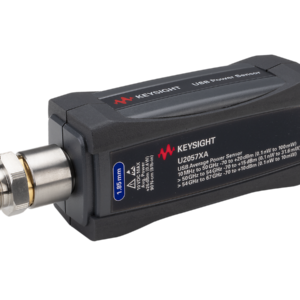
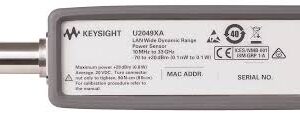
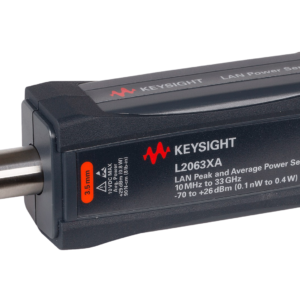
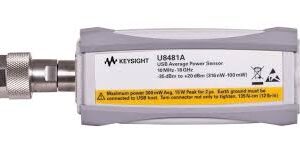
The Keysight U2063XA is a USB-connected average power sensor that delivers accurate power measurements from 10 MHz to 33 GHz with a dynamic range of -70 dBm to +26 dBm. Built for R&D, manufacturing, and system integration environments, it captures and analyzes modulated, pulsed, and continuous wave signals with zero dead time measurement capability. The sensor achieves up to 50,000 readings per second in real-time operation, supported by variable sampling up to 1 MSa/s and 1 MSa of onboard memory for extended data acquisition.
– Technical Specifications
• Frequency Range: 10 MHz to 33 GHz
• Power Range: -70 dBm to +26 dBm (average and peak)
• Measurement Speed: Up to 50,000 readings/second (real-time)
• Sampling Rate: Variable, up to 1 MSa/s
• Memory Capacity: Up to 1 MSa
• Connector Type: 3.5 mm (male)
• USB Cable (Standard): 5 ft (1.5 m); optional lengths available at 10 ft and 16.4 ft
• Physical Dimensions: 5.8″ L × 1.7″ W × 1.4″ H; 0.66 lbs
– Key Features
• Zero dead time measurement ensures complete capture of continuous pulse sequences
• Internal zero and calibration functions reduce setup time and measurement uncertainty
• Trigger I/O with TTL output enables synchronization of multiple sensors and accurate low-level signal triggering
• Full dynamic range operation in average mode and time-selectivity average measurements
• Modulated signal measurement across all supported frequencies
– Typical Applications
• Wireless power measurements (GSM, EDGE, WCDMA, WLAN, LTE)
• Radar signal analysis (DME)
• Broadband RF and microwave power characterization
• Pulsed signal measurement and analysis
– Compatibility & Integration
The U2063XA includes BenchVue Basic Power Meter/Sensor Control and Analysis App (BV0007B) for instrument control, data logging, and visualization without programming. Built-in presets for common radar and wireless signals accelerate test setup. LabVIEW and LabWindows/CVI drivers via National Instruments support automated test environments.








Reviews
There are no reviews yet.