


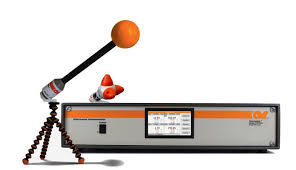
The Ametek OCS 500N6.1 is an EMC test instrument that generates damped oscillatory waves and ring waves to evaluate the electromagnetic compatibility of electronic equipment. It simulates transient disturbances on power, control, and signal lines, assessing device robustness under electrical stress conditions. The instrument supports testing per IEC 61000-4-18, IEC 61000-4-12, ANSI/IEEE C62.41, and IEC 61000-4-10 standards, making it essential for laboratory, industrial, and research environments requiring rigorous EMC validation.
– Technical Specifications
Damped Oscillatory Waves (DOW)
• Frequencies: 100 kHz and 1 MHz
• Open Circuit Voltage (HV output): 250 V to 3,000 V ±10%
• Line Output Voltage: 250 V to 2,500 V ±10%
• Rise Time: 75 ns ±20%
• Source Impedance: 200 Ω ±20% (also 12 Ω or 30 Ω ±20%)
• Peak Short Circuit Current: Max. 500 A @ 12 Ω; Max. 200 A @ 30 Ω
• Repetition Rate: Max. 50/s @ 100 kHz; Max. 500/s @ 1 MHz
• Burst Duration: At least 2 s
• Polarity: Positive, Negative
• Decay Ratios: Peak 2 to Peak 1 (0.4–1.1); Peak 3 to Peak 2 (0.4–0.8); Peak 4 to Peak 3 (0.4–0.8); Peak 5 > 50% of Peak 1; Peak 10 < 50% of Peak 1
Ring Wave (RWG)
• Open Circuit Voltage: Up to 6 kV
• Rise Time: 0.5 µs ±30%
• Oscillation Frequency: 100 kHz ±10%
• Peak Current (Short Circuit): 200–500 A
Coupling and Decoupling Network (CDN)
• Built-in CDN; 1-phase configuration
• Current Rating: 16 A per line
• Supply: 250 V / 16 A AC/DC
• Coupling: Line to line, Line(s) to ground (PE)
– Key Features
• Trigger modes: Automatic, Manual, External
• Synchronization: 0° to 360° (1° resolution)
• CRO Trigger output: 5 V signal
• Control interfaces: USB, GPIB (IEEE 488)
• Magnetic field testing: External coil compatible (IEC 61000-4-10)
– General Specifications
• Dimensions: 19" / 6 HU
• Weight: Approx. 28 kg
• Operating Temperature: 10° C to 35° C
• Relative Humidity: Max. 85%, non-condensing
• Atmospheric Pressure: 86 kPa to 106 kPa
– Typical Applications
EMC compliance testing for power electronics, telecommunications equipment, industrial controls, and signal integrity validation in transient-prone environments.








Reviews
There are no reviews yet.