
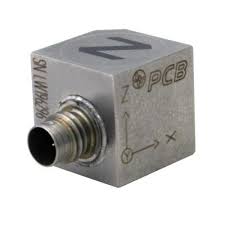

The Amphenol/PCB Piezotronics 356A02 is a triaxial ceramic shear ICP accelerometer engineered for simultaneous three-axis vibration measurement in demanding industrial and test environments. This compact, hermetically sealed sensor delivers 10 mV/g sensitivity across a ±500 g measurement range with exceptional linearity and low transverse cross-axis coupling.
– Technical Specifications
Acceleration Measurement
• Sensitivity: 10 mV/g (±10%) / 1.02 mV/(m/s²) (±10%)
• Measurement range: ±500 g pk / ±4900 m/s² pk
• Overload limit (shock): ±7000 g pk / ±68,600 m/s² pk
• Non-linearity: ≤1% at 400 g; ≤2% at 500 g
• Transverse sensitivity: ≤5%
• Broadband resolution (1–10,000 Hz): 0.0005 g rms / 0.005 m/s² rms
Frequency Response
• Usable range (±5%): 1 to 5000 Hz
• Usable range (±10%): 0.5 to 6000 Hz
• Resonant frequency: ≥25 kHz
• Spectral noise: 150 µg/√Hz @ 1 Hz; 25 µg/√Hz @ 10 Hz; 10 µg/√Hz @ 100 Hz; 5 µg/√Hz @ 1 kHz
Environmental
• Operating temperature: -65 to +250 °F [-54 to +121 °C]
• Data valid to 325 °F (163 °C) with HT option
• Base strain sensitivity: 0.001 g/µε / 0.01 (m/s²)/µε
Electrical Interface
• Excitation voltage: 20 to 30 VDC
• Constant current excitation: 2 to 20 mA
• Output impedance: ≤200 Ohm
• Output bias voltage: 8 to 12 VDC (or 8.5 to 13.0 VDC; adds 1.0 VDC with TEDS option)
• Discharge time constant: 0.6 to 2.0 sec
• Settling time (within 10% of bias): <5 sec
– Key Features
• Ceramic sensing element with shear geometry
• Titanium hermetically sealed housing
• Compact form factor: 0.55 × 0.80 × 0.55 in (14.0 × 20.3 × 14.0 mm)
• Weight: 0.37 oz (10.5 g)
• 1/4-28 4-pin electrical connector
• ICP constant-current powered architecture
– Typical Applications
• Aircraft structure and engine vibration monitoring
• Launch vehicle and spacecraft qualification testing
• Machinery condition monitoring in high-temperature environments
• Modal analysis and dynamic structural testing
• Bearing and component fatigue assessment
– Compatibility & Integration
The 356A02 integrates with standard ICP signal conditioning equipment accepting 20–30 VDC excitation and 2–20 mA constant current sources. TEDS option available for automated sensor configuration in networked test systems.






Reviews
There are no reviews yet.