
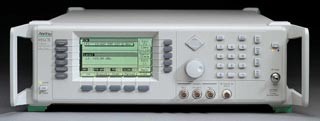

The Anritsu 68037B is a synthesized CW generator delivering precision signal generation across the 2.0 GHz to 20.0 GHz frequency range. It combines ultra-low phase noise, accurate leveled power output, and programmable frequency agility to support local oscillator replacement, component analysis, signal simulation, and ATE applications in telecommunications and microwave testing. The instrument excels in demanding laboratory and field environments where signal integrity and measurement repeatability are critical.
– Technical Specifications
Frequency Performance
• Frequency range: 2.0 GHz to 20.0 GHz
• Frequency resolution: 100.0 mHz (Option 11 offers 0.1 Hz)
• Frequency switching time: <5 ms for step sweeps <100 MHz; <15 ms + 1 ms/GHz step or <40 ms maximum, whichever is less
• Programmable frequency agility: up to 1000 non-sequential frequencies via GPIB control
Output Power
• Power range: -140 dBm to +13 dBm (guaranteed leveled to +17 dBm across 2.0–20.0 GHz)
• Power control: 0.01 dB step resolution for accurate leveling during receiver sensitivity measurements
Signal Purity
• Phase noise: -100 dBc/Hz at 10 kHz offset from 10 GHz
• Harmonics: -30 dBc typical
• Spurious signals: -70 dBc typical
Modulation Capabilities
• Internal modulation: AM, FM, phase modulation (ØM), and pulse modulation
• External modulation: AM and FM via external signals
• Pulse modulation: 1 ns to 100 ms duration; supports doublet, triplet, or quadruplet configurations for radar blind spot testing
• Complex modulation: user-downloadable waveforms; 7 internal generators including Gaussian noise and arbitrary waveforms; simultaneous synchronized modulations supported
Sweep Functionality
• CW or step sweep operation
• Step sweep: 1 to 10,000 steps with customizable step sizes
• Manual sweep: stepped, phase-locked frequency adjustment
• Digital frequency sweep capability
– Key Features
• Phase-locked step sweep via GPIB programming for rapid frequency addressing
• Low spurious output (-70 dBc typical) ensures clean signal delivery
• Compact interface supporting remote control via GPIB and RS-232
– Typical Applications
• Local oscillator replacement in receiver chains
• Component characterization and validation testing
• Signal simulation for system-level testing
• Automated test equipment integration
• Radar and microwave subsystem development
– Compatibility & Integration
Remote control via GPIB and RS-232 interfaces enables seamless integration into automated test systems and laboratory automation frameworks.








Reviews
There are no reviews yet.