
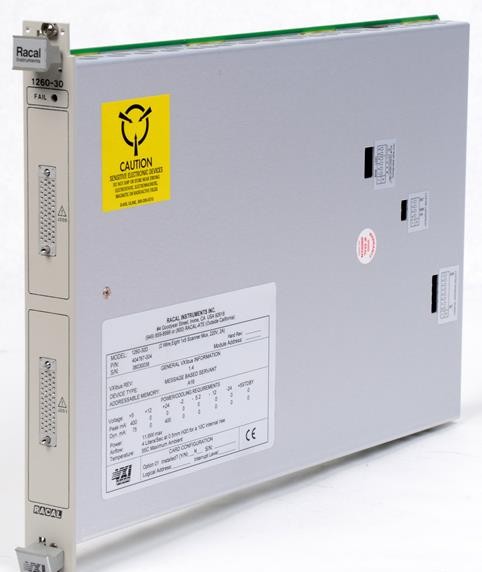

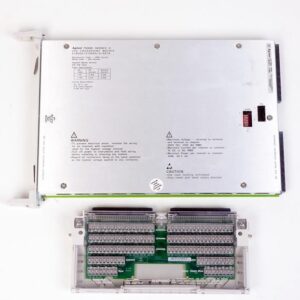
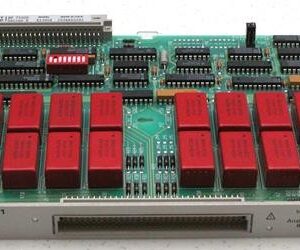
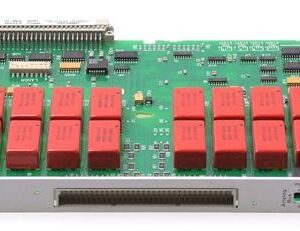
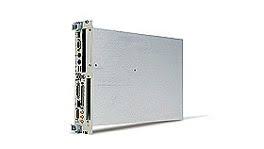
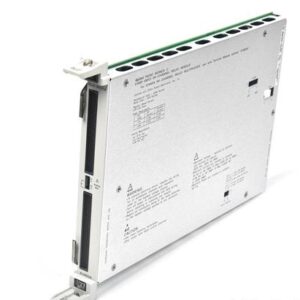
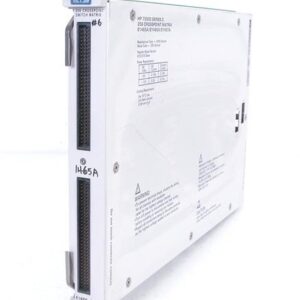
The Astronics/EADS/Racal 1260-30C is a high-power multiplexer VXI module engineered for signal routing and switching in automated test equipment systems. This C-size, single-slot VXIbus module delivers flexible channel configurations with switching ratings up to 250V and 2A per channel, making it suitable for both DC and AC test applications across laboratory and industrial environments.
## Technical Specifications
**Switching Capacity & Configurations**
• Maximum voltage: 220V DC or 250V AC RMS (terminal-terminal or terminal-chassis)
• Maximum current: 2A per channel
• Maximum power: 60W DC or 62.5V A per channel
• Quad 1×10 multiplexer architecture configurable as one 1×40, two 1×20, four 1×10, or eight 1×5 two-wire network
**DC Performance**
• Path resistance: 10⁹ Ω
**AC Performance (50Ω load)**
• Bandwidth (−3 dB): Typical 35 MHz
• Open channel capacitance: <25 pF
• Channel-chassis capacitance: <25 pF
• High-low capacitance: <50 pF
• Insertion loss: <0.2 dB @ 100 kHz, <0.25 dB @ 1 MHz, <0.5 dB @ 10 MHz
• Crosstalk: <−75 dB @ 100 kHz, <−60 dB @ 1 MHz, <−40 dB @ 10 MHz
**Power Requirements**
• +5V: 1A nominal (0.4A without Option 01; 2.8A with Option 01)
• +24V: 10 mA per energized relay
**Physical & Environmental**
• VXIbus C-size form factor, single-slot module
• Operating temperature: 0°C to +55°C
• Non-operating temperature: −40°C to +71°C
• Relative humidity: 95% ±5% non-condensing at 30°C
## Key Features
• Relay coil current monitoring for confidence checking
• User-supplied component mounting holes and terminator circuit pads
• CE Mark compliance for RF emissions, immunity, and electrical safety standards
• Message-based and register-based control via Option 01T interface (Option 01 Smart Card required)
## Typical Applications
Data logging, process monitoring, and multi-channel signal switching in automated test environments requiring high-voltage and high-current switching with low crosstalk.
## Compatibility & Integration
VXIbus C-size, single-slot module integrating directly into VXI-based ATE systems via message and register-based control protocols.








Reviews
There are no reviews yet.