
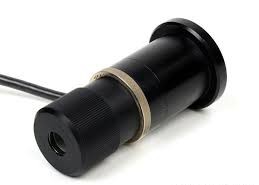

The Burleigh SA-91 is a high-finesse Fabry-Perot interferometer for precision spectral characterization of narrow-band lasers and optical sources. Built on confocal mirror geometry with thermally stable Invar construction, it delivers high spectral resolution across the visible through near-infrared spectrum. The instrument measures optical path differences, coherence length, laser linewidth, longitudinal mode structure, and frequency stability with exceptional accuracy.
– Technical Specifications
• Cavity Design: Confocal mirror geometry
• Free Spectral Range: 2 GHz or 8 GHz
• Finesse: >200 for wavelengths 300 for wavelengths ≥1000 nm
• Minimum Resolvable Bandwidth: FSR/Finesse
• Wavelength Range: 450 nm to 1.8 µm (interchangeable mirror sets); UltraBand™ coverage exceeds 250 nm per set
• Mirror Reflectivity: 99.7% nominal
• Transmission: >10%
• Input Aperture: 1 mm
• PZT Scan Distance: 1.2 µm/1000 V
• PZT Non-Linearity: <1%
• Scan Non-Linearity: <0.1% (with RG-91 electronic compensation)
• Construction: Thermally stable Invar
– Key Features
• Interchangeable mirror sets span 450 nm to 1.8 µm without requiring instrument redesign
• UltraBand™ wavelength coverage reduces number of mirror set changes needed during multi-wavelength experiments
• High finesse enables sub-nanometer resolution
• Four-axis alignment mount (SA-900) supports precise cavity positioning
• Integrated PZT scanning with low non-linearity and electronic linearization
– Typical Applications
• Laser linewidth measurement
• Longitudinal mode structure analysis
• Frequency stability measurements
• Wavelength calibration
• Fiber dispersion analysis
• Optical path difference measurements
• Surface measurements
– Compatibility & Integration
The SA-91 operates within a modular system: the RG-91 Ramp Generator supplies piezoelectric scanning voltage with adjustable range, zero offset, and rate, plus non-linearity correction. The DA-100 Detector/Amplifier provides 0.1 V/mW to 1 V/µW sensitivity, 0.3–100 kHz bandwidth, and minimum detectable power of 1 nW (silicon, 633 nm) or 2 nW (germanium, 1.5 µm).










Reviews
There are no reviews yet.