


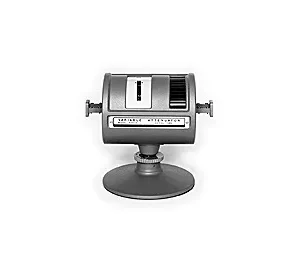
A continuously variable waveguide attenuator is a passive RF component that reduces signal power in waveguide systems through manual control. Precision mechanical design—including micrometer adjustment or dial-based mechanisms—enables rapid, repeatable attenuation adjustments suitable for calibration, test and measurement, and dynamic signal level control across diverse RF applications.
– Technical Specifications
Attenuation Range: 0 to 30 dB or 0 to 60 dB; some models offer up to 40 dB or 50 dB.
Frequency Range: Variable by waveguide size. Examples include 1.12 GHz to 1.70 GHz (WR650), 33 GHz to 110 GHz, 50 GHz to 1100 GHz, and up to 500 GHz. Models span WR2.2 through WR650 waveguide sizes.
Waveguide Sizes: WR10, WR12, WR15, WR62, WR75, WR90, WR112, WR137, WR159, WR187, WR229, WR284, WR430, WR650, and custom sizes down to WR2.2.
Insertion Loss: 0.5 dB to 1 dB for standard variable models; hybrid designs can achieve as low as 0.05 dB with maximum 0.5 dB.
VSWR: 1.15:1 maximum; fixed attenuators achieve less than 1.10:1.
Attenuation Accuracy: Better than ±0.35 dB at center frequency; some models offer 1% accuracy.
Power Handling: Ranges from low-power to high-power RF applications; hybrid styles support full transmitter power.
– Key Features
• Repeatable performance through micrometer-screw or multi-turn dial adjustment
• Split-block construction for precision and mechanical stability
• Locking mechanism available to maintain set attenuation during repetitive measurements
• Knurled finger-control knobs or micrometer drives for precise manual adjustment
• Standard flange options: UG387/U-M, UBR120, CPR137F, plus custom international styles
• Materials: copper waveguide with brass flanges standard; brass, copper, and aluminum options available
• Compact, lightweight design; some models standardized at 1″ length for higher frequencies
– Typical Applications
• Signal calibration and level control
• RF test and measurement setups
• Dynamic attenuation adjustment in communication systems
– Compatibility & Integration
Available in standard waveguide configurations from microwave through sub-terahertz frequencies. Custom flange specifications accommodated to integrate with existing test benches and RF systems.







Reviews
There are no reviews yet.