

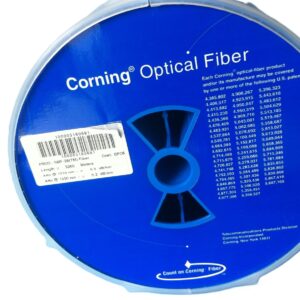
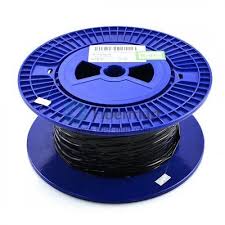
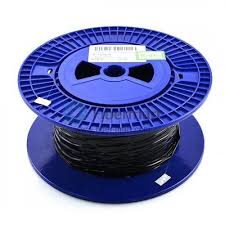
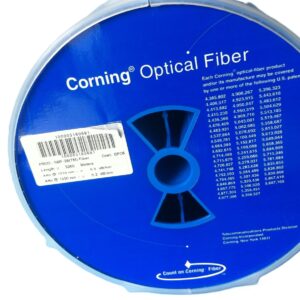
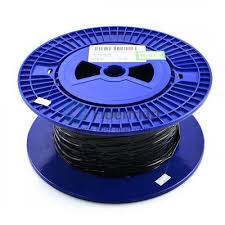
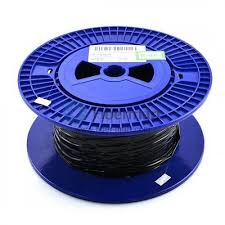
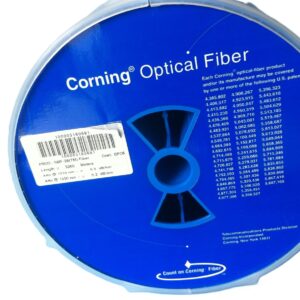
The Corning LEAF® Optical Bare Fiber is a non-zero dispersion-shifted fiber (NZDSF) engineered for long-haul and metropolitan network deployments. Compliant with ITU-T G.655.D, this 20 km spool delivers low attenuation and controlled dispersion across the C and L bands, enabling extended optical reach with reduced amplifier and regenerator requirements. The fiber’s larger mode-field diameter (9.2–10.0 µm at 1550 nm) improves splicing performance with standard single-mode fibers and minimizes non-linear effects in DWDM systems. Its proven compatibility with installed photonic components makes it a reliable choice for optical infrastructure.
– Technical Specifications
Optical Performance
• Fiber Type: Non-Zero Dispersion-Shifted Fiber (NZDSF)
• Standard: ITU-T G.655.D compliant
• Attenuation at 1550 nm: ≤ 0.19 dB/km (typical ≤ 0.22 dB/km)
• Attenuation at 1625 nm: ≤ 0.21 dB/km (typical ≤ 0.24 dB/km)
• Attenuation across C-band (1525–1575 nm): Max. difference ≤ 0.02 dB/km
• Attenuation across C+L band (1550–1625 nm): Max. difference ≤ 0.03 dB/km
• Dispersion at 1530 nm: 2.0 to 5.5 ps/(nm•km)
• Dispersion at 1565 nm: 4.5 to 6.0 ps/(nm•km)
• Dispersion at 1625 nm: 5.8 to 11.2 ps/(nm•km)
• Mode-Field Diameter at 1550 nm: 9.2 to 10.0 µm (typical 9.6 ± 0.4 µm)
• Numerical Aperture: 0.14 (at 1550 nm)
• Polarization Mode Dispersion (PMD Link Design Value): ≤ 0.04 ps/√km
• Maximum Individual Fiber PMD: ≤ 0.1 ps/√km
• Point Discontinuity: ≤ 0.05 dB at 1550 nm
• Cable Cutoff Wavelength: ≤ 1360 nm
Mechanical Properties
• Coating: Dual acrylate CPC® system
• Coating Diameter: 245 µm nominal
• Proof Test: ≥ 100 kpsi (0.69 GPa) applied across entire fiber length
• Macrobend Loss (16 mm mandrel, 1 turn): ≤ 0.50 dB at 1550/1625 nm
• Macrobend Loss (30 mm mandrel, 100 turns): ≤ 0.05 dB at 1550/1625 nm
• Length: 20,000 meters (20 km) with ± 300 m tolerance
– Key Features
• Low attenuation minimizes signal degradation over extended distances
• Controlled dispersion supports high-capacity DWDM transmission
• Reduced non-linear effects enable higher launch power and channel count
• Improved splicing compatibility with SMF-28 and standard single-mode fibers
• Low PMD meets ITU-T G.650-2 Appendix IV requirements
– Typical Applications
• Long-haul terrestrial and submarine optical networks
• Metropolitan area network (MAN) deployments
• Multi-channel DWDM systems
• High-capacity backbone infrastructure
– Compatibility & Integration
LEAF fiber integrates with installed photonic component bases and operates in systems designed for standard single-mode fiber. Its larger MFD reduces splicing loss when transitioning between fiber types, simplifying network expansion and maintenance.


Reviews
There are no reviews yet.