


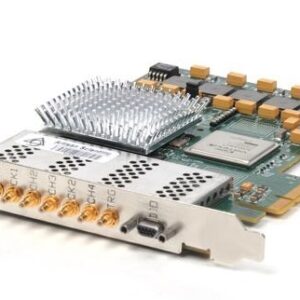
The Curtiss-Wright/Systran SL240 is a high-performance FibreXtreme Serial FPDP PMC module engineered for demanding real-time data acquisition and DSP processing. Built on ANSI/VITA 17.1-2003 sFPDP protocol, it delivers multiple gigabit-per-second data rates with minimal latency and zero CPU overhead, enabling reliable sensor-to-DSP streaming in radar, sonar, medical imaging, and video production systems.
## Technical Specifications
• **Protocol:** ANSI/VITA 17.1-2003 Serial FPDP (sFPDP)
• **Data Rates:** 1.0625 Gb/s, 2.5 Gb/s, 5.0 Gb/s
• **Sustained Throughput:** Up to 494 MB/s per channel
• **Channel Configuration:** 1, 2, or 4 full-speed channels; up to 4 independent data streams to host
• **Fiber Extension:** Up to 50 km via FibreXtreme connections
• **On-Board Memory:** 256 MB DDR2 SDRAM (PCIe); 512 MB DDR2 SDRAM (XMC); 16 Mb Flash; 2 kB EEPROM
• **Host Interface:** 64-bit, 66 MHz PCI bus
• **Form Factors:** PCIe (x16/x32 compatible) and XMC x8
## Key Features
• Direct Memory Access (DMA) engine handles single transactions up to 64 MB without processor intervention
• Hardware-based flow control prevents data loss at receiver with fixed-frame data insertion
• Integrated interrupt controller reports link failure, transaction completion, and buffer status
• Byte/word swapping on DMA and register paths provides system flexibility
• Multi-level error detection and status reporting
• Support for front and rear I/O configurations
• Point-to-point topology support
## Typical Applications
• Real-time radar and sonar signal processing
• Medical imaging systems with high-speed data streaming
• Video production and acquisition pipelines
• Sensor array processing requiring low-latency DSP interconnect
• High-throughput telemetry and data logging
## Compatibility & Integration
The SL240 integrates into existing PCI and CompactPCI-based systems via PCIe or XMC form factors. Its specialized sFPDP protocol optimization eliminates traditional overhead associated with general-purpose network stacks, delivering deterministic, low-latency performance essential for time-critical applications.










Reviews
There are no reviews yet.