


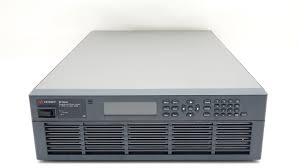
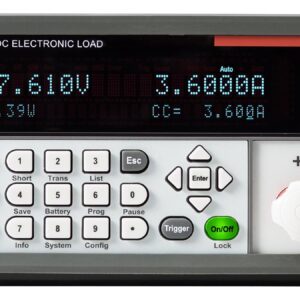
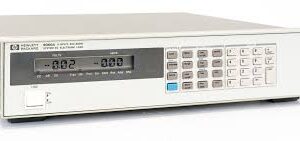
DC electronic loads are active current-sinking instruments that simulate and test DC power sources including power supplies, batteries, solar panels, and DC-DC converters. These devices absorb power from the source under test, enabling engineers to evaluate stability, efficiency, and protective features under controlled and dynamic load conditions. Unlike passive resistive loads, electronic loads offer programmable control over voltage, current, and power with operation across multiple modes to emulate real-world scenarios with high accuracy and repeatability.
– Technical Specifications
Power Ratings: Available from tens of watts to hundreds of kilowatts. Common ratings include 150 W, 175 W, 200 W, 250 W, 300 W, 350 W, 500 W, 600 W, 750 W, 1200 W, 1500 W, 2400 W, and up to 240 kW for modular high-power systems.
Voltage Range: 0 V to over 2000 VDC, with specific configurations supporting 500 V, 600 V, and 2000 VDC operation. Some models operate stably down to 0 V.
Current Capability: From milliamperes to thousands of amperes. High-power configurations reach 720 A, 1200 A, 2000 A and beyond.
Measurement Accuracy: Voltage and current accuracies typically ±0.05%, with advanced models achieving ±0.015% + 0.015% F.S. for voltage and ±0.04% + 0.04% F.S. for current. 16-bit resolution standard.
Transient Response: Dynamic load switching frequencies up to 25 kHz, 50 kHz, or 100 kHz depending on model. Adjustable slew rates available in constant current mode.
– Key Features
• Constant Current (CC): Maintains set current independent of input voltage; tests current limiting and battery discharge characteristics
• Constant Voltage (CV): Adjusts current to maintain specified voltage; evaluates voltage regulation performance
• Constant Power (CP): Dynamically adjusts voltage and current to maintain constant power draw
• Constant Resistance (CR): Behaves as fixed resistor with current proportional to input voltage; simulates resistive loads and battery capacity testing
• Complex Modes: Selected models support combined modes including CR+CC, CV+CC, and CV+CR for intricate test scenarios
– Typical Applications
Power supply validation, battery discharge and capacity testing, solar panel characterization, DC-DC converter performance analysis, and protective feature verification under dynamic load conditions.
– Compatibility & Integration
Electronic loads interface with standard DC sources and power systems. Programmable control architecture enables integration into automated test systems and bench environments across voltage ranges from millivolts to kilovolt levels.









Reviews
There are no reviews yet.