
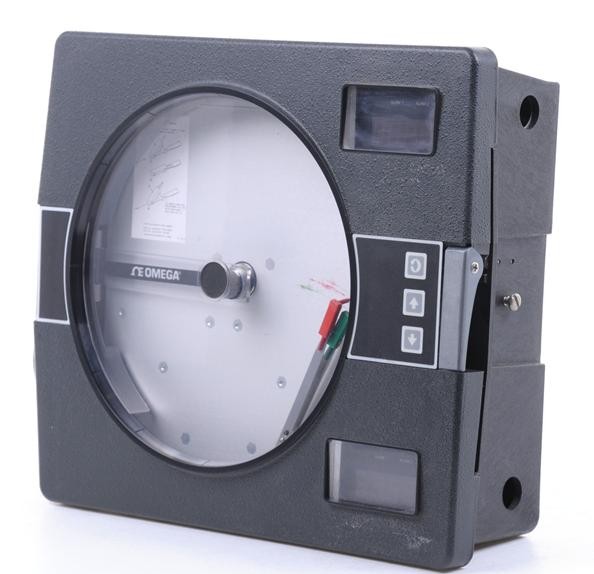

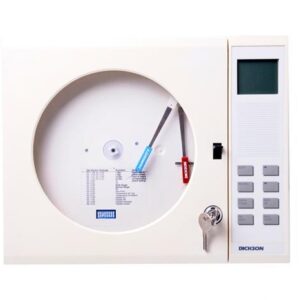
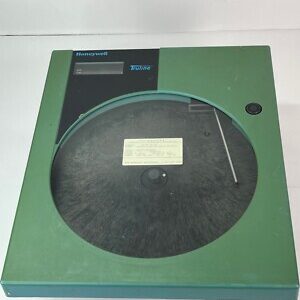
The CT7110 is a microprocessor-based 2-pen circular chart recorder that measures, displays, records, and controls up to two process variables simultaneously. This instrument accepts universal inputs across millivolts, volts, milliamps, thermocouples (J, K, T, E, N, R, S, B, C types), and RTDs, making it suitable for diverse industrial monitoring applications. The 250 mm circular chart pairs with dual 4-digit LED displays offering user-configurable resolution and integrated filtering.
## Technical Specifications
**Input Capability**
• Thermocouple ranges: J (0–760°C), K (0–1360°C), T (−220–400°C), E (0–750°C), N (0–1300°C), R (200–1650°C), S (200–1650°C), B (200–1800°C), C (200–2300°C)
• RTD input: 100 Ω (0.00385 Ω/Ω/°C) from −140–400°C
• Voltage DC: 0–25 mV, 0–50 mV, 10–50 mV, 0–5 V, 1–5 V
• Current measurement: 4–20 mA DC
• Programmable isolated inputs with sensor fault detection (“Hi”/”Lo”/”SnSr” display states)
**Measurement Accuracy**
• Thermocouple (J, K, T, E, N) and RTD: ±0.25% of reading + 1° at 25°C
• Type R, S, B, C: ±0.25% of span at 25°C
• mVdc/Vdc: ±0.25% of scaled span plus 1 LSB
• Ambient temperature drift: 0.01% of span per °C deviation
• Record error: ±0.5% of chart span typical, ±1.0% maximum
• Pen response: 20 seconds full scale deflection
**Chart and Display**
• 250 mm circular chart with programmable rotation speed (0.1–999.9 hours per revolution)
• Display resolution: 0.1 or 1° (T/C and RTD); 0.001, 0.01, 0.1, or 1 (mVdc/Vdc)
• Pen resolution: 0.15% of chart span
• Display/record filter: 1–20 scans averaging
## Key Features
• Dual independent pen channels with 4-digit LED readouts per channel
• Self-compensating calibration with memory storage
• User-configurable pen response to error conditions (0 or 100% of chart span)
• Process value output error limit: ±0.5% of span
## Typical Applications
Industrial process monitoring, temperature recording across wide ranges, multi-parameter data logging in manufacturing and environmental control systems.
## Compatibility & Integration
Programmable isolated inputs support direct sensor connection without external signal conditioning.









Reviews
There are no reviews yet.