
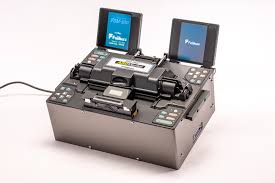

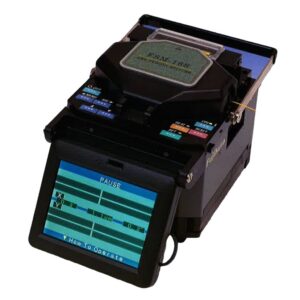
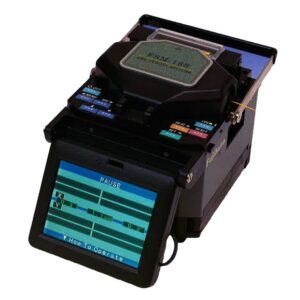
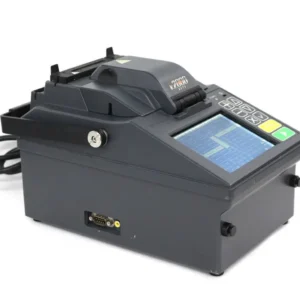
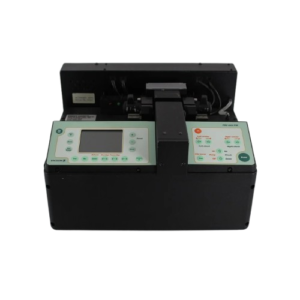
The Fujikura FSM-100P Fusion Splicer delivers high-precision optical fiber splicing for telecommunications, research, and specialized network deployments. It handles standard single-fiber splicing across SMF, NZDSF, MMF, EDF, DCF, large diameter fibers (LDF), polarization-maintaining fibers (PANDA, PM types), and specialty geometries including holey and photonic crystal fibers. The instrument combines proprietary State of the ARC™ plasma zone control with Split V-groove clamping and IPA2 (Interrelation Profile Alignment 2) rotational alignment to achieve low-loss splices on complex fiber profiles—octagonal, elliptical core, and multi-core structures.
– Technical Specifications
Fiber Compatibility
• Cladding diameter: 60 µm to 500 µm
• Coating diameter: 100 µm to 2000 µm
• Cleave length (glass clamp): 8 mm to 10 mm (standard 9 mm)
• Cleave length (coating clamp): 3 mm to 5 mm (standard 4 mm)
Splice Loss Performance
• SMF: 0.03 dB
• NZDSF/LDF: 0.05 dB
• MMF: 0.02 dB
• PMF: 0.06 dB
Polarization Performance
• PANDA PMF: 40 dB at 0.6° rotational offset
• PM AUTO: -32 dB at 1.4° rotational offset
– Key Features
• IPA2 rotational alignment for octagonal, elliptical, and multi-core fibers
• Rotational Z stages for PMF splicing with precise angular control
• Profile Alignment System (PAS) and Warm Splice Image (WSI) for loss estimation
• Enhanced arc calibration methods: melt-back and axis offset-back modes for specialty fibers
• Fibre Processing Software (FPS) for tapers and ball lenses
• Multi-step programmable glass processing operations
• Enhanced sweep arc technology for extended tapering applications
– Typical Applications
• Telecommunications fiber networks and long-haul deployments
• Large diameter fiber splicing for industrial and research applications
• Polarization-maintaining fiber systems requiring low crosstalk
• Photonic crystal and holey fiber integration
• Custom fiber geometry processing and optical component fabrication
– Compatibility & Integration
The FSM-100P processes single fibers with coating diameters up to 2000 µm and operates across standard ITU-T fiber types (G.652, G.655, G.651) plus specialty variants. Standard cleave requirements are 9 mm glass and 4 mm coating lengths.











Reviews
There are no reviews yet.