


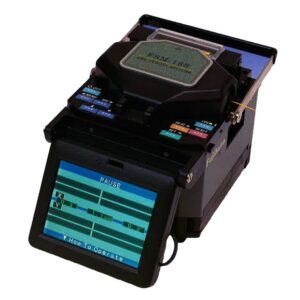
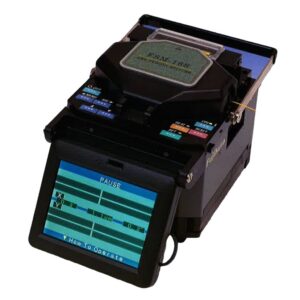
The Fujikura FSM-30S is an automatic core alignment fusion splicer engineered for single-mode, dispersion-shifted, and multimode optical fibers across telecommunications and field deployment. It employs Profile Alignment System (PAS) technology for direct core monitoring, delivering ultra-low splice loss with accurate loss estimation independent of fiber age or quality. The splicer automatically aligns fiber cores, inspects cleave geometry, and applies eccentricity correction to maintain precision in demanding environments.
## Technical Specifications
**Fiber Splicing**
• Single-mode fiber (SM) at 1310 nm
• Dispersion-shifted fiber (DS) at 1550 nm
• Cutoff wavelength-shifted fiber (CS) at 1550 nm
• Multimode fiber (MM)
• Erbium-doped fiber (ED)
**Physical & Operating Range**
• Coated fiber diameter: 250 to 900 µm
• Cleaved fiber length: 8 to 16 mm
• Operating temperature: -10°C to +50°C
• Humidity: 0 to 95% RH
• Altitude: Up to 3,500 meters
**Splice Performance**
• Single-mode typical loss: 0.02 dB
• Multimode typical loss: 0.01 dB
• Dispersion-shifted fiber typical loss: 0.05 dB
• Return loss: ≥60 dB
• Mechanical proof test: 2 N (23 KPSI) standard; 4.6 N (50 KPSI) optional
**Attenuation Control**
• Intentional splice loss range: 0.5 dB to 20 dB
• Stepped attenuation: 1 dB to 15 dB in 1 dB increments
## Key Features
• Automatic arc power adjustment with integrated analysis software
• Eccentricity correction function (ECF) for core/cladding misalignment
• Programmable tube heater with heating profile control
• Cleaved fiber end-angle alarm adjustable to 5°
• Dust detection function
• Internal memory: 100 splice data sets; expandable via PCMCIA card (up to 224,000 results)
• CCD camera with high-resolution viewing on X and Y axes
• 4″ or 5″ LCD monitor with direct sunlight visibility
• RS-232C interface
## Physical Specifications
• Dimensions: 21 cm W × 18.7 cm D × 17 cm H
## Typical Applications
Telecommunications network deployment, field fiber termination, and optical system installation where low splice loss and environmental compensation are critical.












Reviews
There are no reviews yet.