
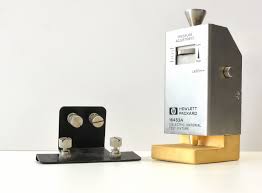

The HP/Agilent 16453A Dielectric Material Test Fixture is a parallel plate measurement instrument for characterizing the dielectric properties of solid materials. It employs a flexible electrode that automatically conforms to the material surface, eliminating manual adjustment and ensuring consistent electrode contact across the measurement area. The fixture connects to impedance analyzers including the Keysight E4991A, E4991B, Agilent 4291A/B, and HP 4291A to measure dielectric constant and loss tangent. Its self-adjusting electrode design provides reliable results across a broad frequency spectrum without the parallelism constraints of fixed-electrode fixtures.
– Technical Specifications
• Frequency Range: 1 MHz to 1.0 GHz
• DC Bias Voltage: ±40 V maximum
• AC+DC Voltage: ±42 V peak maximum
• Material Thickness: 0.3 mm to 3 mm
• Material Diameter: ≥15 mm
• Measured Properties: Dielectric constant and loss tangent
• Electrode Type: Flexible, self-adjusting
• Measurement Method: Parallel plate capacitive
• Connector Type: Precision coaxial
– Key Features
• Flexible electrode automatically conforms to sample surface geometry
• Eliminates manual parallelism adjustment required in competing fixtures
• Operates from 1 MHz to 1.0 GHz, spanning RF to microwave frequencies
• Supports simultaneous DC bias (±40 V) with AC excitation (±42 V peak)
• Compact form factor: 130 mm (H) × 50 mm (W) × 60 mm (D), weighing 600 g
• Wide operating temperature range: −55°C to +200°C
• Tolerates humid environments up to 95% RH at wet bulb <40°C
– Typical Applications
• Dielectric property characterization in material research
• Quality control testing of insulators and polymer films
• Permittivity and loss tangent measurement in electronics manufacturing
• Frequency-dependent dielectric analysis across RF bands
– Compatibility & Integration
The fixture integrates with Keysight E4991A, E4991B, Agilent 4291A/B, and HP 4291A impedance analyzers. Relative complex permittivity is calculated by the analyzer firmware (e.g., option 002). Connection via precision coaxial connectors ensures impedance-matched signal transmission.







Reviews
There are no reviews yet.