
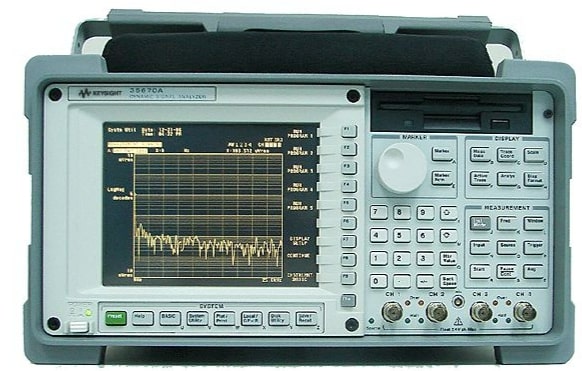

The HP/Agilent 35670A FFT Dynamic Signal Analyzer delivers multi-channel dynamic signal measurement across DC to 102.4 kHz. Purpose-built for vibration analysis, noise characterization, machinery diagnostics, and control system evaluation, this instrument combines laboratory-grade measurement accuracy with field-portable deployment flexibility.
– Technical Specifications
Frequency Coverage
• 102.4 kHz (1 channel), 51.2 kHz (2 channels), 25.6 kHz (4 channels)
• Real-time bandwidth: 25.6 kHz single-channel
• Resolution: 100, 200, 400, 800, or 1600 lines
• Minimum FFT resolution: 122 µHz (1600-line display); 61 µHz with digital zoom
Dynamic Range & Accuracy
• Dynamic range: 90 dB typical; 130 dB in swept-sine mode
• Amplitude accuracy (FFT): ±0.15 dB
• Cross-channel amplitude match: ±0.04 dB and ±0.5°
• Phase accuracy (relative to external trigger, 16 time averages): ±4.0°
• FFT cross-channel amplitude: ±0.04 dB (0.46%)
Signal Capture & Processing
• Time record: 0.8 to 6 Msamples standard; up to 6+ Msamples with option UFC
• Signal averaging: RMS, time exponential, RMS exponential, peak hold (1 to 9,999,999 averages)
• Overlap processing and preview time record control
Triggering & Synchronization
• Modes: Continuous, external (analog/TTL), internal channel-based, source synchronized, GPIB, armed (automatic/manual)
• Pre- and post-trigger measurement delay capability
• RPM step and time step triggering
Input Interface
• Tachometer: ±4 V or ±20 V range; 40 mV or 200 mV resolution; up to 2048 pulses/rev
• AC/DC coupling, floating or grounded input options
• Auto-range (up-only, up/down), manual range selection
• Anti-alias filters selectable
– Key Features
• Waveform sources: random, burst random, periodic chirp, burst chirp, pink noise, sine, swept-sine (Option 1D2), arbitrary (Option 1D4)
• Measurement domains: FFT, histogram, correlation, time capture, frequency response, power spectrum, coherence, cross-spectrum, PSD, orbit, auto/cross-correlation, PDF, CDF, network analysis
• Optional capabilities: octave analysis (1D1), computed order tracking (1D0), curve fit and synthesis (1D3)
• Overload reject and fast averaging controls
– Typical Applications
Vibration and structural diagnostics, acoustic noise measurement, rotating machinery condition monitoring, electromechanical system characterization, transfer function estimation, modal analysis support.









Reviews
There are no reviews yet.