


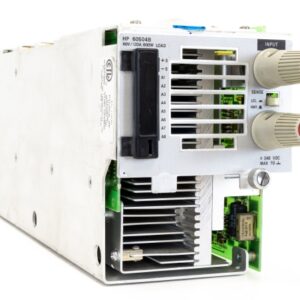
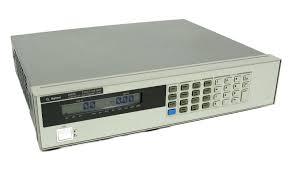
The HP/Agilent 6060B is a 300 W DC electronic load that evaluates DC power sources and components across research, production, and incoming inspection applications. Operating in constant current, constant voltage, and constant resistance modes, it delivers stable, repeatable test conditions with built-in measurement capabilities and comprehensive protection. The unit accepts voltage inputs from 3 to 60 VDC and current loads up to 60 A, with minimum operating voltage of 2 V (1.2 V typical).
– Technical Specifications
Electrical Performance
• Voltage Range: 3 to 60 VDC
• Current Range: 0 to 60 A
• Maximum Power: 300 W (at 40°C)
• Constant Current: 0–6 A and 0–60 A ranges; 0.1% ±75 mA accuracy; 10 mA regulation
• Constant Voltage: 0.1% ±50 mV accuracy; 10 mV regulation with remote sense
• Constant Resistance: 0.033 to 10,000 Ω across three ranges; 0.3% to 0.8% accuracy
• Current Readback: 0.05% ±65 mA
• Voltage Readback: ±(0.05% + 45 mV)
• Ripple and Noise: 4 mA rms current, 6 mV rms voltage (20 Hz to 10 MHz)
Transient Generator
• Frequency Range: 0.25 Hz to 10 kHz
• Slew Rate: 1 A/ms to 5 A/µs (60 A range)
– Key Features
• Three independent operating modes for flexible power supply characterization
• Transient waveform generation with programmable frequency and slew rates
• Remote voltage sensing for precision regulation in distributed power systems
• GPIB (IEEE-488) interface for automated test sequences and real-time readback
• Analog programming and monitor outputs for legacy and custom integration
• Multi-layer protection: over-voltage, over-current, over-temperature, over-power, and reverse polarity
• Compact form factor: 425.5 mm W × 88.1 mm H × 330 mm D; 6.12 kg
• Optional front-panel input connectors (Option 020) for bench-top flexibility
– Typical Applications
Power supply validation and characterization, battery charger testing, photovoltaic inverter evaluation, DC-DC converter qualification, and thermal stress validation in production environments.
– Compatibility & Integration
GPIB control enables integration into automated test systems. Analog programming inputs accept external voltage signals for current-mode control. Remote sensing terminals support precision regulation over extended cable runs.








Reviews
There are no reviews yet.