


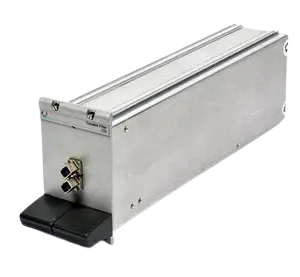
The ILX Lightwave FOM-7900B is a modular multi-channel source mainframe for precise control and characterization of laser diodes and optical sources across WDM and CWDM applications. Accommodating up to 8 plug-in modules per mainframe, it scales to 200 channels across 25 linked units under single GPIB control, delivering synchronized modulation to 500 kHz and integrating laser sources, switches, and power meters for EDFA, SOA, and fiber optic component testing.
## Technical Specifications
**Mainframe Architecture**
• Up to 8 plug-in modules per mainframe
• System scaling: up to 25 additional FOM-7900B mainframes (200 channels total)
• Single GPIB address control for all scaled systems
• Two-line, 20-character VFD display
**Modulation Capabilities**
• Internal synchronous modulation to 500 kHz
• Modulation waveform frequency: 0.1 – 500 kHz
• Modulation input frequency: 1 – 500 kHz
• Processor-controlled 100% depth, 50% duty cycle
• Synchronous modulation across all active modules (1–500 kHz range)
• Mainframe trigger for multi-module output synchronization
**Control & Interface**
• GPIB/IEEE-488.2 and RS-232 remote programming
• LabVIEW instrument drivers included
• Front-panel user interface
**Laser Source Modules (FOS-79800 Series)**
• Wavelength range: 1475–1625 nm (user-specified ITU or custom)
• Service channels: 1310, 1480, 1510, 1625 nm
• S, C, and L-band WDM DFB sources
• Tuning range: 1.7 nm per channel at 0.001 nm resolution
• Maximum power: 9–20 mW per channel
• Wavelength stability: ±3 pm
• Power stability: ±0.003 dB
• Attenuation accuracy: ±0.1 dB
• Coherence control: linewidth 30 MHz to 1 GHz
• Optional shutter and PM alignment
**Fiber Optic Switch Module (FOS-79710)**
• Configuration: 1×4
• Wavelength range: 1290–1650 nm
• Insertion loss: ≤1.7 dB
• Crosstalk: ≤−80 dB
• Polarization dependent loss: ≤0.05 dB
• Repeatability: <±0.03 dB
• Switching time: 300 ms + 16 ms/channel
• Return loss: <55 dB
• Switch life: <10 million cycles
• Bi-directional operation; timed, random, sequential, or triggered modes
## Key Features
• Picometer-resolution wavelength setting
• Simultaneous multi-module parameter control and monitoring
• Broad wavelength coverage for long-haul and metro networks
• Low insertion loss and high crosstalk isolation
• Cost-effective platform for R&D and production test
## Typical Applications
• WDM and CWDM system characterization
• EDFA and SOA testing
• Fiber optic component evaluation
• Multi-wavelength source integration
• High-channel-count automated test systems
## Compatibility & Integration
Standard GPIB and RS-232 interfaces enable integration into existing automated test environments. LabVIEW drivers support rapid application development and system customization.









Reviews
There are no reviews yet.