
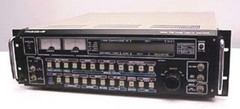

The Ithaco 3961B is a dual-phase lock-in amplifier engineered for precision measurement of weak AC signals in high-noise environments. Phase-sensitive detection enables signal extraction and amplification across multiple disciplines including physics, chemistry, and engineering research where detection of subtle signals drives discovery.
## Technical Specifications
**Signal Detection & Sensitivity**
• Frequency range: 0.5 Hz to 200 kHz (0.5 Hz mode); DC to 500 kHz (alternative mode)
• Input sensitivity: 100 nV to 1 V full scale across 15 ranges (1-3.16-10 steps)
• Maximum resolution: 1 nV
• Noise floor: Less than 10 µV RMS; less than 1 nV/√Hz
• Dynamic reserve: 90 dB at 1 Hz
**Input & Output**
• Input configuration: Single-ended or true differential
• Input impedance: 10 MΩ // 40 ± 10 pF or 1 MΩ // 20 pF
• Common mode rejection: 110 dB or greater
• Output voltage: ±10 V maximum
**Signal Processing**
• Gain range: 1 to 1000
• Time constant range: 1 µs to 10 ks
• Phase control: 0 to 360 degrees
• Harmonic distortion: Less than 0.1% at 1 kHz, 1 V RMS output
• Linearity: Less than 0.1% from 10 Hz to 100 kHz
## Key Features
• TTL/CMOS compatible reference input from 1 Hz to 100 kHz
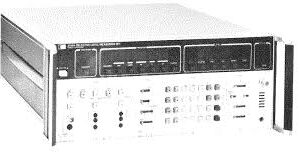
• 19″ rack-mountable form factor, 3U height (17.0″ W × 20.0″ D × 5.25″ H; 31 lb)
• Dual-phase detection for enhanced signal discrimination
• 15-step sensitivity scaling for flexible measurement ranges
## Typical Applications
Phase-locked detection of modulated signals, materials characterization, impedance spectroscopy, lock-in measurements of periodic phenomena, and weak-signal recovery in presence of broadband noise.
## Compatibility & Integration
IEEE and RS-232 interfaces support remote control and data acquisition. Operates on 115/230 V AC or 120/220 V AC, 50/60 Hz (50 VA maximum; 2.0 A / 1.0 A at 47–63 Hz, single phase).










Reviews
There are no reviews yet.