
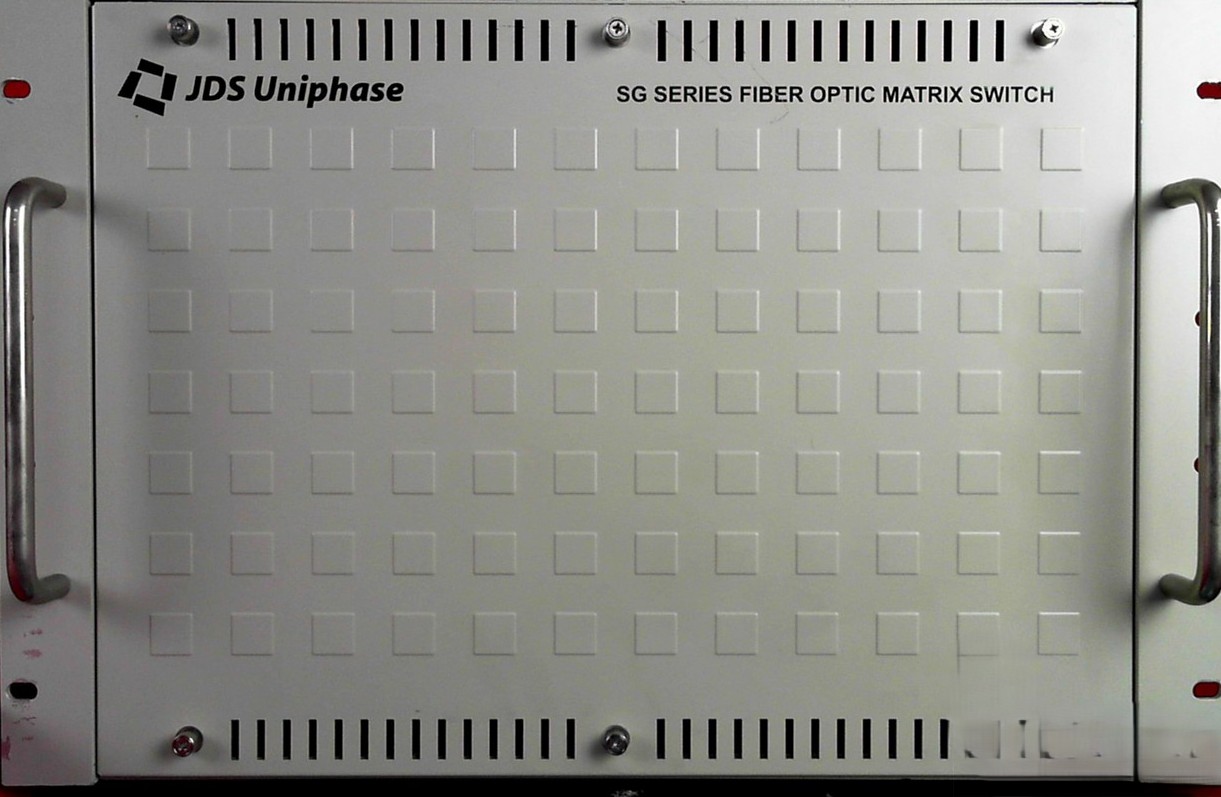

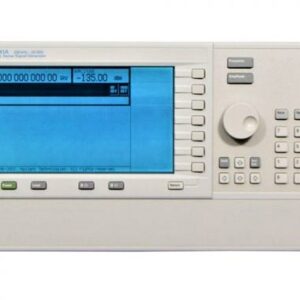
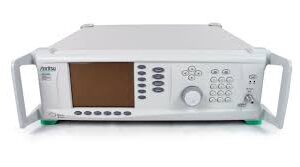
The JDS Uniphase SG is a signal generation module engineered for integration into larger test and measurement systems. It delivers stable, accurate signal sourcing across telecommunications and research applications. The compact modular design supports remote control via standard interfaces while maintaining reliable performance in demanding measurement environments.
## Technical Specifications
The SG series encompasses signal generation and optical matrix switching architectures. Standard signal generator configurations operate across a frequency range of 10 to 3000 MHz with output levels from −20 to +12 dBm and frequency setting resolution of 1 Hz. Frequency stability and aging characteristics are specified, with phase noise performance defined at multiple offset frequencies.
Optical matrix switch variants feature expanded beam technology with precision stepper-motor alignment. Wavelength operation spans 1270 to 1670 nm for 3U height configurations supporting up to 8×8 optical channels, with extended architectures capable of 64 total inputs and outputs. These switches are characterized by low insertion loss across the operational bandwidth.
## Key Features
• Modular form factor for system integration into larger architectures
• RS232 and GPIB control interfaces for remote command and monitoring
• LabVIEW drivers available for programmatic control
• Optical matrix variants leverage expanded beam switching with motorized channel alignment
• Frequency setting resolution of 1 Hz
• Defined frequency stability and aging specifications
• Phase noise performance across multiple offset frequencies
## Typical Applications
• Broadband fiber network reconfiguration
• Data communication and multimedia network testing
• Optical channel switching and signal routing
• Telecommunications system validation
• Research and development measurement campaigns
## Compatibility & Integration
The module integrates into larger test platforms via RS232 and GPIB command interfaces. Optical variants accept standard fiber connections consistent with telecommunications infrastructure. System-level compatibility depends on integration architecture and available interface support.





Reviews
There are no reviews yet.