


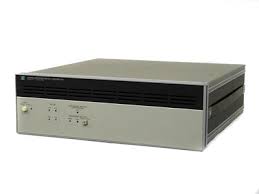
The Keithley 155 Null Detector Microvoltmeter is a solid-state DC voltage measurement instrument engineered for null detection and precision microvolt measurements in standards labs, development environments, production testing, and research settings. Battery-powered operation minimizes ground loops and high-frequency interference, delivering performance where sensitivity and stability are non-negotiable.
– Technical Specifications
Measurement Ranges
• Full scale: ±1 µV to ±1000 V across 19 overlapping 1x and 3x ranges
• Null balance approach with adjustable voltage cancellation for extreme precision
• Minimum resolution: Better than 150 nV; 1 µV on sensitive range
Accuracy & Output
• Meter output: ±2% of full scale (exclusive of noise and drift)
• Recorder output: ±1% of full scale (exclusive of noise and drift)
Input Characteristics
• Input impedance: 100 MΩ (3 V–1 kV ranges), 10 MΩ (300 mV–1 V ranges), 1 MΩ (1 µV–100 mV ranges)
• Zero shift with source resistance: Less than 10⁻¹¹ V/Ω
Noise & Stability
• Meter noise: Less than 0.03 µV RMS (0.15 µV peak-to-peak) on most sensitive range with input shorted
• Zero drift: Less than 0.5 µV per 24 hours; typically less than 0.1 µV per °C
Rejection Performance
• Common mode rejection ratio (CMRR): Greater than 140 dB (DC or 50/60 Hz)
• Normal mode rejection ratio (NMRR): 100 dB on most sensitive range; decreases to 20 dB on 10 mV and higher ranges
Overload Protection & Recovery
• Momentary overload rating: Up to 1200 V peak without damage
• Recovery from 100 V overloads: Within 5 seconds on 30 mV and higher ranges; within 20 seconds on 1 µV range
Response Time
• Rise time (10%–90%): 1 second on 10 µV range and above; 5 seconds on 1 µV range
Zero Suppression
• Range: ±25 µV
– Key Features
• Battery-powered design using four internally mounted carbon-zinc batteries (2N6) for >1000 hours continuous operation
• Exceptional common mode rejection eliminates ground loop contamination
• Sub-nanovolt resolution enables measurements in metrology-grade applications
– Typical Applications
Precision DC voltage null detection, calibration standards verification, low-level signal measurement, thermoelectric device characterization, sensor validation.
– Compatibility & Integration
Recorder output available for data logging. Input shielding recommended for microvolt-level measurements in electromagnetically noisy environments.







Reviews
There are no reviews yet.