
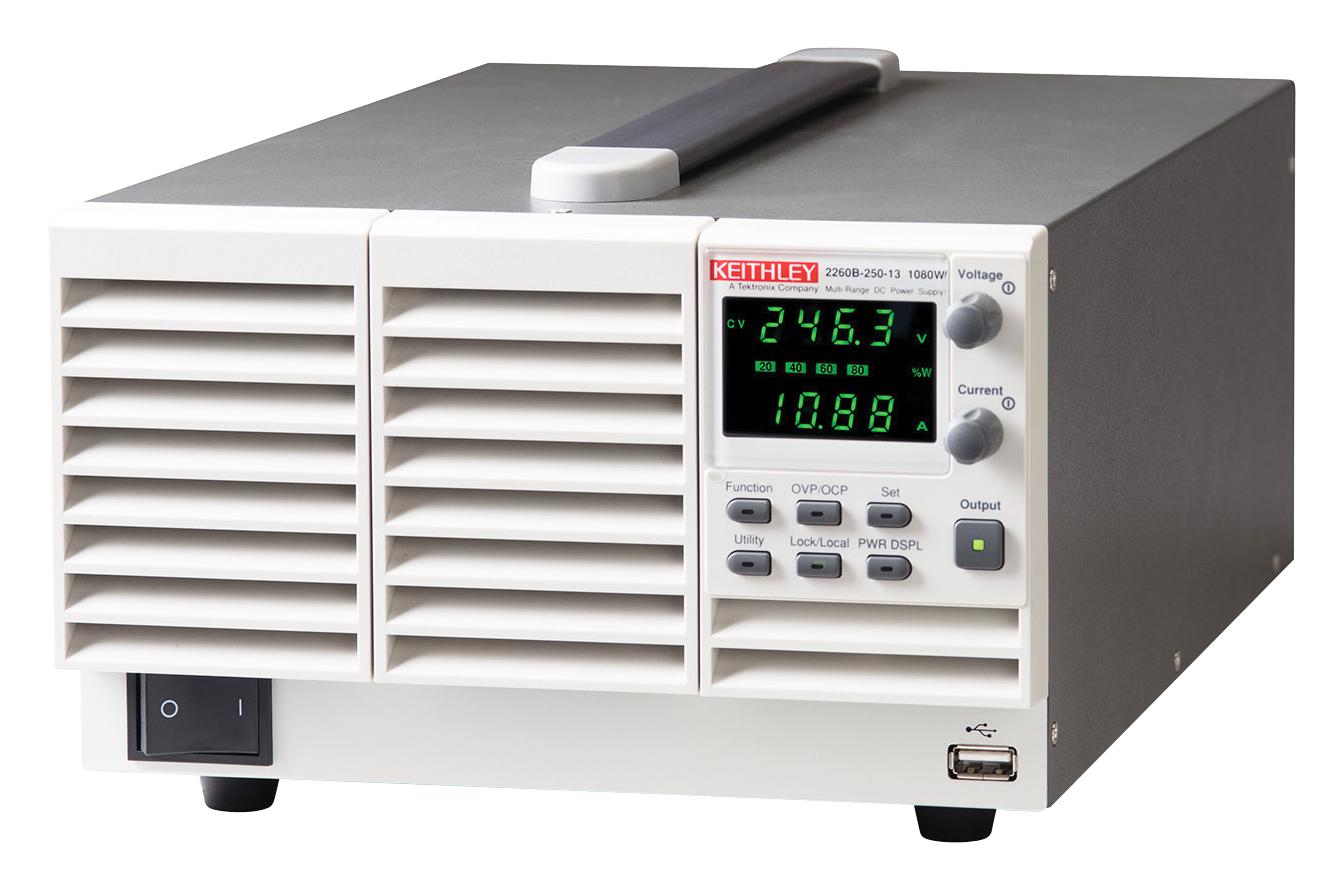

The Keithley 2260B-80-40 is a 1080 W programmable DC power supply engineered for research, development, quality control, and production testing environments. It delivers 80 V at 40.5 A with independently programmable voltage and current outputs, slew rate control, and integrated protection circuitry. The unit accepts 85–265 VAC single-phase input and interfaces via USB, LAN, and optional GPIB connectivity for automated test sequences and remote operation.
## Technical Specifications
• Output Power: 1080 W (rated); ~105% maximum
• Output Voltage: 0–80 V, slew rate 0.1–160 V/s
• Output Current: 0–40.5 A, slew rate 0.01–81.00 A/s (rising and falling)
• Voltage Accuracy: ±0.5% of rated output voltage
• Current Accuracy: ±1% of rated output current
• Temperature Coefficient: 200 ppm/°C after 30 min warm-up
• Input: 85–265 VAC, 50/60 Hz, single phase; power factor 0.97–0.99 typical
• Hold-up Time: ≥20 ms
• Dimensions: 71 mm W × 124 mm H × 350 mm D (approximately 3 kg)
## Key Features
• Overvoltage, overcurrent, and overtemperature protection with automatic output shutdown
• Low AC input protection (AC-FAIL) turns output off
• Programmable voltage and current rise/fall times to prevent inrush damage to low-impedance loads
• Constant current priority mode minimizes overshoot when powering LEDs
• Programmable output resistance simulates battery characteristics
• Internal test sequence mode generates custom voltage waveforms
• Analog control input (26-pin rear connector) for voltage/current regulation and status monitoring
• Front-panel USB Type-A host and rear-panel USB Type-B control
• Remote sensing terminals reduce lead-loss effects in long-cable installations
## Typical Applications
• LED driver and power supply testing
• Battery simulation and emulation
• Device characterization and stress testing
• Automated production line verification
• Research and prototype validation
## Compatibility & Integration
USB and LAN interfaces enable direct instrument control and data logging. Optional GPIB adapter (2260B-GPIB-USB) extends legacy test system compatibility. Analog input allows integration into existing analog control architectures without external interfaces.







Reviews
There are no reviews yet.