


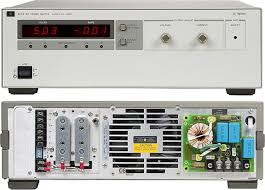
The Keithley 228A is a programmable voltage/current source delivering precision sourcing and sinking across four quadrants with up to 100 W of power handling. It operates as a voltage supply, current supply, or active load, making it ideal for component characterization, power supply testing, and device validation. Front-panel programmability and IEEE-488 remote control enable both manual and automated test sequences.
## Technical Specifications
The 228A provides three voltage ranges (100 V, 10 V, 1 V) and three current ranges (10 A, 1 A, 100 mA), with maximum output of 100 V and 10 A. Output noise spans 2.5 mVp-p to 0.35 mVp-p across the 0.1–300 Hz band depending on range; broadband noise reaches 15 mVp-p (0.1–300 kHz) and 25 mVp-p (0.1–20 MHz).
Transient recovery time is less than 1 ms for 90% settling on resistive loads. Output inductance measures 100 µH typical; output capacitance is 0.2 µF typical. Output resistance varies by range: 10⁴ Ω to 10⁶ Ω minimum (current ranges), and 100 mΩ to 100 µΩ maximum (voltage ranges). Common-mode voltage tolerance is 100 V DC.
Line regulation holds output changes below 0.01% across specified AC mains variations. Remote sensing corrects for up to 0.5 V per output lead drop, with 5 Ω maximum per sense lead; rated output resistance is maintained at ≤0.5 Ω per sense lead.
## Key Features
• Dual 3½-digit LED displays (0.5 inch high) show programmed and actual output values
• 100-point battery-backed program memory stores voltage, current, and dwell time settings
• Dwell time range: 10 ms to 1000 s with ±(0.05% + 2 ms) accuracy
• 4-quadrant operation sources or sinks without polarity or power derating
• Internal forced-air cooling and 10 minute warm-up to rated accuracy
• Analog and digital self-test at power-on with continuous power supply and temperature monitoring
• Modulation input: 6.8 kΩ input resistance
• Non-inductive load requirement
## Typical Applications
Component burn-in and stress testing, power semiconductor characterization, battery simulator operation, precision load emulation, and automated device qualification sequences.
## Compatibility & Integration
IEEE-488 interface enables integration into GPIB-based measurement systems and automated test platforms.







Reviews
There are no reviews yet.