


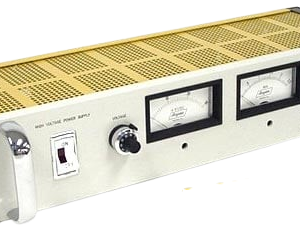
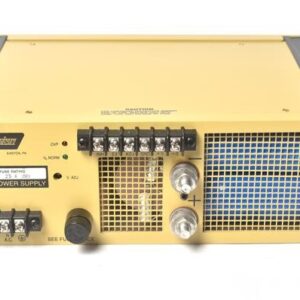
The Kepco MSK 40-2.5M is a 100-watt single-output DC power supply engineered for laboratory and maintenance testing applications requiring precise voltage and current regulation. The unit delivers 0–40V DC at 0–2.5A DC with exceptionally tight load and source regulation, making it suitable for demanding bench-level work. It employs a high-gain linear series-pass stabilizer circuit with automatic crossover between voltage and current modes, coupled with integrated overvoltage protection via SCR latching circuit. The Preview switch enables offline presetting of output parameters on digital meters before load connection—a critical safety feature for test setup workflows.
## Technical Specifications
• Output: 100W (0–40V DC, 0–2.5A DC)
• Input: Selectable 105–125V AC or 210–250V AC
• Load Regulation (Voltage Mode): 0.01%
• Load Regulation (Current Mode): 0.05%
• Source Regulation: 0.01% (voltage and current modes)
• 8-Hour Drift: 0.01% (voltage mode), 0.02% (current mode)
• Temperature Coefficient: 0.01%/°C (voltage mode), 0.02%/°C (current mode)
• Output Ripple & Noise: 0.5mV RMS / 3.0mV peak-to-peak (voltage mode); 0.02% RMS / 0.1% peak-to-peak (current mode)
• Crowbar Protection: SCR latching circuit; transient response 2.5ms or greater
• Remote Sensing: Available via +S and −S binding posts for voltage error compensation
## Key Features
• Ten-turn voltage and current controls for fine-resolution adjustment
• Preview switch for offline parameter configuration
• Heavy-duty front-panel binding posts (wire or banana-plug compatible)
• Built-in low-speed fan cooling
• MIL-STD-461 EMC compliant
• Remote programming via variable resistance input
• Digital display readouts for voltage and current settings
## Typical Applications
• Component characterization and burn-in testing
• Equipment maintenance and troubleshooting
• Bench laboratory power delivery
## Compatibility & Integration
Input mains voltage is factory-selectable and reconfigurable by trained service personnel. Remote sensing and programming terminals enable external load-voltage compensation and automated test sequences.









Reviews
There are no reviews yet.