
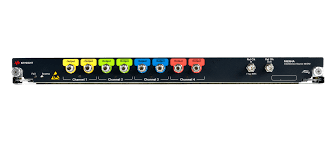

The Keysight M8054A Interference Source is a 1-slot AXIe module designed to generate controlled interference signals for stress-testing high-speed communication receivers up to 32 GHz. It produces sinusoidal and random (Gaussian/white noise) interference across four differential output channels, enabling engineers to characterize receiver sensitivity and validate performance under realistic interference conditions across PCIe, Ethernet, USB, SATA, and other digital interface standards.
– Technical Specifications
Frequency & Bandwidth
• Frequency range: 160 kHz to 32 GHz
• Adjustable bandwidth: 160 kHz to 32 GHz
• Random interference bandwidth: 26 GHz (supporting signals to 52 Gbaud)
• Frequency accuracy: ±2 ppm
Output Channels & Impedance
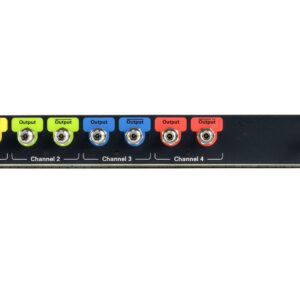
• Four differential output channels
• 50 Ω nominal impedance
• 2.4 mm female connectors
• Single-ended amplitude: up to 1 Vpp (1 mV resolution)
• Differential amplitude: up to 2 Vpp
• Amplitude correction factor: 0 to 10
• Single-ended voltage window: -1.0 V to +2.5 V into 50 Ω
• Termination voltage window: -600 mV to +1.1 V
• Skew (output pair): ±7 ps typical
• Skew (normal to complement): 3 ps maximum
Interference Modes
• Sinusoidal interference (SI): single-tone and two-tone, 1 MHz to 12 GHz modulation frequency
• Common mode (CMSI) and differential mode (DMSI) sinusoidal interference
• Random interference (RI): flat spectrum, crest factor >5
Signal Support
• Symbol rates up to 64 Gbaud
• Line coding: NRZ, PAM4
– Key Features
• Integrated offset control with dynamic range dependent on amplitude setting
• Offset example: -945 mV to +549 mV at 100 mV amplitude
• Direct differential outputs eliminate balun requirement
• Adjustable per-channel amplitude correction for loss compensation
– Typical Applications
• PCIe 4/5 receiver testing
• IEEE 802.3 bs, bj, cd, by compliance validation
• OIF CEI-56G characterization
• SAS and Thunderbolt receiver stress testing
• 400GbE, USB, and SATA signal integrity assessment
– Compatibility & Integration
• AXIe form factor enables integration into M8000 series test systems
• Controlled via M8070B system software










Reviews
There are no reviews yet.