
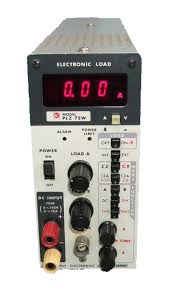

The Kikusui PLZ72W is a DC electronic load instrument designed for testing and validation of power sources, batteries, and DC output devices. Operating from 0 V to 60 V and drawing up to 120 A at 720 W maximum power, it delivers three independent operating modes—Constant Current, Constant Voltage, and Constant Resistance—with fine control resolution and fast transient response. Built-in protection circuits guard against overcurrent, overvoltage, over-temperature, and reverse input conditions.
– Technical Specifications
Input Range: 0–60 V, 0–120 A, 720 W maximum
Operating Modes:
• Constant Current (CC)
• Constant Voltage (CV)
• Constant Resistance (CR)
Control Resolution:
• Current: 10 mA
• Voltage: 10 mV
• Resistance: 0.1 Ω
Accuracy:
• CC Mode: ±0.2% of setting + 0.1% of full scale
• CV Mode: ±0.2% of setting + 0.1% of full scale
• CR Mode: ±1% of setting + 0.2% of full scale
Response Time: Less than 2 ms for load transitions from 10% to 90% at rated current.
Temperature Coefficient:
• Current: ±0.1% of setting / °C
• Voltage: ±0.1% of setting / °C
• Resistance: ±0.2% of setting / °C
Environmental: 0–40 °C operating temperature, 20–80% RH non-condensing.
– Key Features
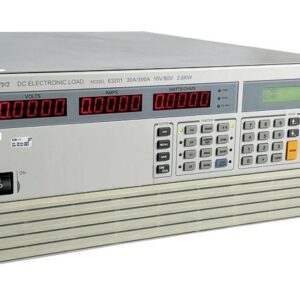
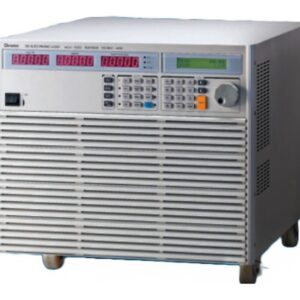
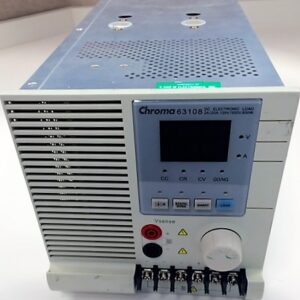
• Digital display for real-time Voltage, Current, and Power monitoring
• Front-panel control knobs and buttons for mode selection and parameter adjustment
• Remote control interface for external monitoring and command
• Overcurrent, overvoltage, and over-temperature protection
• Internal reverse input protection via fuse
• Benchtop and rack-mount compatible design
– Typical Applications
• Power supply testing (linear, switching, AC-DC, DC-DC converters)
• Battery charge/discharge validation (lead-acid, lithium-ion, NiMH)
• Fuel cell output characterization
• General DC source evaluation and load simulation
– Compatibility & Integration
The PLZ72W interfaces with a wide range of DC power sources and external control systems via standard remote control connectivity. Front-panel digital display enables direct observation of load parameters without external instrumentation.









Reviews
There are no reviews yet.