
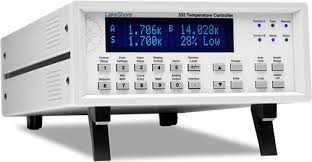

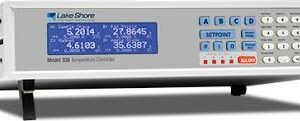
The Lake Shore 332 is a dual-channel temperature controller delivering high-resolution measurement and precise regulation across cryogenic to elevated temperatures. Built on proven architecture with enhanced electronics, it accommodates diode, RTD, and thermocouple sensors from 500 mK to above 800 K depending on sensor selection. Two independent PID control loops with autotuning and zone-based parameter adjustment enable stable operation across extreme temperature spans.
## Technical Specifications
**Sensor Inputs**
• Two independent sensor channels with 24-bit ADC resolution per input
• Supports diode, RTD (NTC, Cernox®), and thermocouple sensors
• Automatically scalable excitation current: 1 µA to 1 mA
• 1 µA excitation available for NTC RTD sensors up to 75 kΩ to minimize self-heating
• 10 µA and 100 µA excitation options; manual range fixing supported
• Sensor excitation current reversal eliminates thermal EMF errors on resistive sensors
• Optical isolation ensures low-noise, repeatable measurements
• Input configuration fixed at order; field reconfiguration not available
• Data acquisition: 10 samples per second per input; display updates twice per second
**Temperature Measurement Ranges**
• NTC RTD: 500 mK and above
• Cernox® thin-film RTD: 0.3 K to 420 K
• Silicon diodes: 1.4 K to above room temperature
• Platinum RTD: 14 K to 873 K (PT-102/3) or 14 K to 673 K (PT-111); typical range 30 K to above 800 K
**Control Architecture**
• Two independent proportional-integral-derivative (PID) control loops
• Autotuning available for both loops; manual PID configuration supported
• Setpoint ramp feature for smooth continuous adjustments
• Zone feature: up to ten temperature zones with automatic parameter adjustment
**Heater Output (Loop 1)**
• Well-regulated variable DC current source
• Optically isolated to minimize interference and ground loops
• Maximum continuous power: 50 W
## Key Features
• Dual independent control channels for simultaneous measurement and regulation
• High-resolution 24-bit conversion minimizes quantization noise
• Flexible excitation current scaling optimizes signal integrity across wide impedance ranges
• Thermal EMF cancellation via current reversal on resistive sensors
• Optical isolation reduces system noise and cross-talk
• Zone-based control enables stable operation across multi-decade temperature ranges
## Typical Applications
Material characterization, cryogenic research, superconductor testing, dilution refrigerator operation, thermal cycling experiments, and precision temperature stabilization in laboratory and industrial settings.


Reviews
There are no reviews yet.