

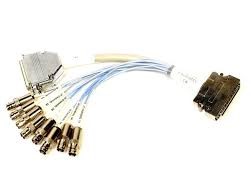
The Lattice HW7265-DL3A ispDOWNLOAD Cable and Adapter enables in-system programming (ISP) of Lattice Semiconductor devices directly from a PC parallel port. This accessory supports real-time hardware modification on production boards, accelerating design cycles, streamlining manufacturing, and enabling field updates across multiple Lattice device families. The cable interfaces via a 25-pin parallel port adapter with RJ-45 connector and offers flexible target board connectivity through flywire, 1×8, 2×5, or 1×10 (.100″ center-spacing) connectors. Programming voltage range spans 1.8V to 5V, accommodating legacy and modern FPGA/CPLD architectures.
– Technical Specifications
• Model: HW7265-DL3A (Lattice Semiconductor)
• Function: In-System Programming Cable and Adapter
• PC Interface: 25-pin Parallel Port with RJ-45 connector
• Programming Voltage: 1.8V to 5V
• Typical Current Draw: 10mA @ VCC
• Target Board Connectors: Flywire, 1×8 (.100″), 2×5 (.100″), 1×10 (.100″) for newer FPGA families
• Signaling: SCKL/TCK, MODE/TMS, SDI/TDI, SDO/TDO, ispEN/Enable/PROG, TRST, DONE
– Key Features
• Supports SC, SCM, XP, XP2, EC, ECP2, ECP2M, MachXO, MachXO2, and 1000/2000/4000 series CPLD families
• Multiple connector options for legacy and current board designs
• 1×10 connector variant enables DONE and INITN signal verification on newer FPGA families
• Target board supplies its own power; cable does not provide board-level power
• Compatible with Lattice ispVM™ System software, Lattice Diamond Programmer, and ispLEVER® Classic
– Typical Applications
• Development and prototyping environments requiring iterative device reconfiguration
• Production programming and field upgrades
• Real-time hardware function modification during board-level debug
– Compatibility & Integration
Works with all Lattice programmable devices spanning FPGA and CPLD families. The 1×10 connector option integrates with the ispDOWNLOAD USB cable for configuration status feedback on newer architectures. Standard JTAG-compatible pin definitions (TDI/TDO, TMS, TCK) ensure predictable integration with established ISP workflows.






Reviews
There are no reviews yet.