

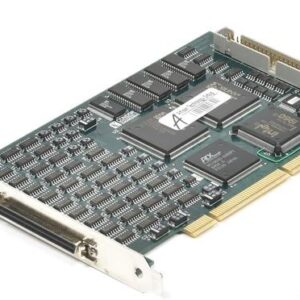
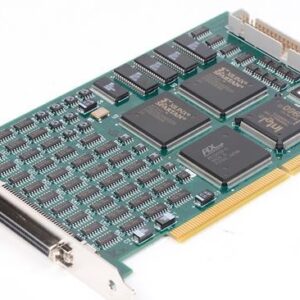
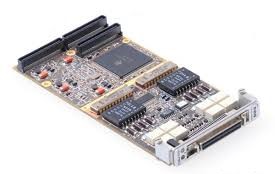
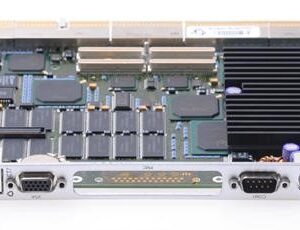
The Mercury Computer Systems RACE++ Series 400-MHz PowerPC 7410 Daughter Card is a high-performance embedded computing module built on a switched-fabric architecture designed for real-time sensor acquisition, signal processing, and concurrent I/O operations. The card integrates the PowerPC 7410 processor at 400 MHz with AltiVec vector technology, enabling parallel execution across multiple data elements—up to four floating-point numbers or sixteen 8-bit integers per vector operation.
– Technical Specifications
Processor & Clock
• PowerPC 7410 microprocessor
• Clock speed: 400 MHz
• Processor bus frequency: 66.66 MHz
Cache & Memory
• L1 cache: 32 KB instruction, 32 KB data
• L2 cache: Up to 2 MB integrated
• SDRAM support: Up to 133 MHz with optional ECC
• Sustained memory bandwidth: 457 MB/s
• Peak memory bandwidth: 800 MB/s
AltiVec Vector Processing
• Parallel vector execution for image and signal processing
• Simultaneous operation on multiple data elements
Interconnect & Fabric
• RACEway switched interconnect: 66.66 MHz, 267 MB/s per connection
• Single crossbar peak bandwidth: Over 1 GB/s (four simultaneous paths)
• Crossbar latency: ~75 ns connection establishment, 15 ns per crossbar
• Fabric interface bandwidth: 267 MB/s
• PCI interface via PCI9030
• VME interface via Tundra Universe-II
• Optional MPX bus interface
Compute Node Architecture
• Two compute nodes per daughtercard
• Each node contains MPC7410, L2 cache, SDRAM, and Mercury-designed ASIC
• ASIC enhances concurrency between arithmetic and I/O operations
– Key Features
• Switched-fabric design eliminates bus-based bottlenecks
• Supports simultaneous input, output, and computing operations
• Conduction-cooled PCB options for rugged environments
• 6U form factor
– Typical Applications
• Real-time signal and image processing
• Embedded sensor data acquisition
• High-concurrency computing tasks requiring parallel vector execution
– Compatibility & Integration
The card integrates with systems supporting PCI, VME, and RACEway interconnects. Dual compute nodes enable load balancing and redundancy in multiboard systems.








Reviews
There are no reviews yet.