

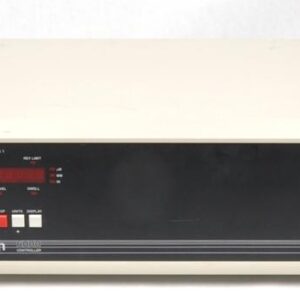
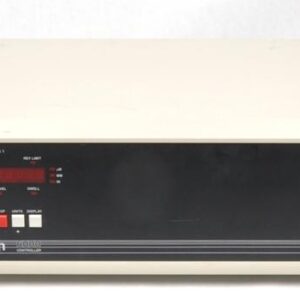
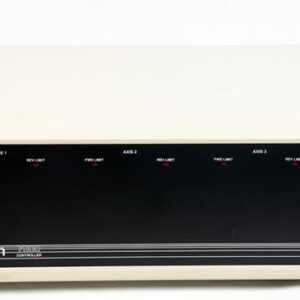
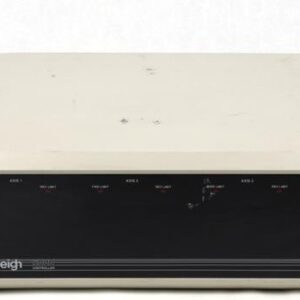
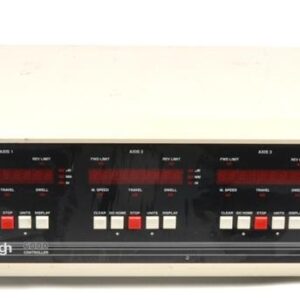
The Newport MM4006 is a multi-axis motion controller and driver engineered for high-precision automation systems requiring simultaneous control of 2 to 8 axes. Built around an 80-bit floating-point, 133 MHz microprocessor, the MM4006 delivers deterministic cycle times of 300 µs (up to 4 axes) or 500 µs (5 to 8 axes), enabling precise trajectory planning, error compensation, and system synchronization across complex multi-axis applications. The controller outputs precision 16-bit DC motor commands and provides 500 W of motor drive power using low-noise PWM amplifiers. It supports DC and stepper motor variants from Newport’s motorized product line, excluding the PM500 series.
– Technical Specifications
• Axes of Control: 2 to 8 axes simultaneously
• Processor: 80-bit floating-point, 133 MHz microprocessor
• Servo Loop Control: Digital PID-FF (feedforward) servo loop
• Cycle Time: 300 µs (up to 4 axes); 500 µs (5 to 8 axes)
• Motor Drive Power: 500 W
• Motor Types Supported: DC and stepper motors (excluding PM500 series)
• DC Motor Command Output: Precision 16-bit
• Trajectory Math: 80-bit floating-point for high-resolution computations
• Analog Input: 4-channel, 12-bit simultaneous acquisition
• Analog Output (Optional): 4-channel for motion-related data (position, speed, following error)
• Digital I/O: 8-line parallel TTL port for synchronization and external device control
– Key Features
• Synchronized and non-synchronized point-to-point positioning modes
• Linear and circular interpolation with 2D continuous path contouring
• Trajectory programming with straight and curved segments
• Over 150 commands with 120 programmable variables
• Conditional logic: if/then/else, do-while, jumps, wait-for routines
• Autonomous operation—no host PC required for high-performance tasks
• Large backlit LCD display with 4 user-configurable soft-keys
• Programmable status display
– Interfaces
• RS-232-C, IEEE-488 (GPIB), and RS-485 communication ports
• 8-axis analog joystick (optional; 2.9 m cable) for manual speed and direction control
– Typical Applications
Multi-axis material handling, precision optical component alignment, laboratory automation, and synchronized motion systems requiring deterministic performance and independent trajectory control.


Reviews
There are no reviews yet.