

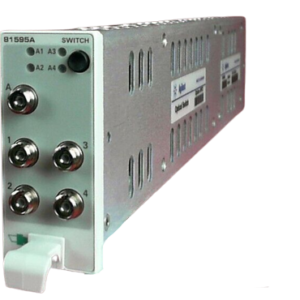
The Newport PTS-FOSW 1×4 Fiber Optic Switch Module routes optical signals from one input port to any of four output ports, with reversible 4×1 operation. This optically passive, bi-directional module is transparent to bit rates and data formats, making it ideal for automated fiber alignment, passive component testing, multi-port device characterization, and fiber optic sensor systems. A single light source and optical meter can test multiple devices or selectively bypass components. PC-controlled remote switching enables automated test sequences, long-term burn-in, and environmental testing.
– Technical Specifications
• Switch Configuration: 1×4 (one input to four outputs); reversible to 4×1
• Fiber Options: Single-Mode 9/125 µm (1270–1630 nm) or Multimode 62.5/125 µm (1270–1630 nm or 750–940 nm)
• Connectors: ST/PC, FC/PC, FC/APC, SC/PC, SC/APC, or bare fiber
• Switching Speed: ≤10 ms typical (adjacent channels)
• Insertion Loss: 0.6 dB typical; 1.0 dB max
• Repeatability: ≤±0.02 dB
• Polarization Dependent Loss (PDL): ≤0.05 dB typical
• Wavelength Dependent Loss (WDL): ≤0.25 dB typical
• Total Dispersion Loss (TDL): ≤0.25 dB typical
• Isolation: ≥55 dB (MM); ≥70 dB (SM)
• Back Reflection: ≥30 dB (MM); ≥50 dB (SM)
• Optical Power Handling: ≤500 mW
• Switching Voltage: +5 VDC
• Mechanical Durability: >10 million cycles
• Control Interface: Electrical (TTL); switch position feedback provided
• Dimensions: 135 × 64 × 32 mm
– Key Features
• Optically passive design with low insertion loss and high isolation
• Low PDL ensures minimal signal degradation across polarization states
• Fast adjacent-channel switching with high mechanical repeatability
• Supports both single-mode and multimode fiber configurations
• Electrical feedback confirms switch state for automated control loops
– Typical Applications
• Automated fiber alignment systems
• Passive optical component and device testing
• Multi-port device characterization
• Fiber optic sensor system integration
• Long-term burn-in and environmental testing
– Compatibility & Integration
The module accommodates standard fiber optic connectors and bare-fiber terminations. Its bi-directional, format-transparent architecture integrates into test benches requiring signal routing across disparate bit rates and wavelength bands.








Reviews
There are no reviews yet.