

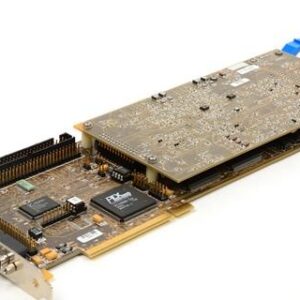
The NI AT-MIO-64F-5 is a multifunction I/O board delivering analog, digital, and timing acquisition and control for PC AT, compatible, and EISA environments. It integrates 12-bit ADC/DAC, programmable gain stages, eight digital I/O lines, and three counter/timers into a single ISA expansion board—purpose-built for measurement automation and system integration.
– Technical Specifications
Analog Input
• ADC Resolution: 12-bit
• Sampling Rate: 5 µsec per sample
• Input Channels: 64 single-ended or 32 differential
• Programmable Gains: 0.5, 1, 2, 5, 10, 50, 100 (unipolar or bipolar)
• Input Ranges: Programmable unipolar or bipolar voltage
• FIFO Buffer: 256-word A/D buffer
• Timing: Internal or external A/D clock
Analog Output
• DAC Resolution: 12-bit (two double-buffered multiplying DACs)
• Output Ranges: Programmable unipolar or bipolar voltage
• Reference Voltage: 10 V onboard
• Update: Internal timer or external signal
Digital I/O
• Channels: 8 lines
• Current Sink: 24 mA per line
Counters/Timers
• Three independent 16-bit counter/timers for frequency counting, event counting, and pulse output
Timing & Triggering
• System Triggers: 4 channels
• Timer-generated interrupts
• RTSI bus interface
• Full DMA support on PC I/O channel (analog input and output)
Interfaces
• Host: ISA bus
• I/O Connector: 50-pin
– Key Features
• Multiplexed ADC architecture supporting up to 64 single-ended channels
• Dual 12-bit DACs with independent output buffering
• Three 16-bit counter/timers enable simultaneous timing operations
• RTSI bus synchronization for multi-board systems
• Direct memory access eliminates CPU bottlenecks during high-rate acquisition
• Cascadable with AMUX-64T multiplexer boards (up to four units; 256 single-ended maximum)
– Typical Applications
• Data acquisition and waveform generation in laboratory instrumentation
• Industrial process monitoring and feedback control
• Frequency and event counting in automated test systems
• Multi-channel sensor signal conditioning
– Compatibility & Integration
The AT-MIO-64F-5 mounts in standard ISA slots and operates with NI-DAQ driver software. Register-level programming is supported. Designed for PC AT, compatible, and EISA architectures; driver availability for modern operating systems may be limited.









Reviews
There are no reviews yet.