

The NI GPIB-140 fiber optic GPIB extender extends IEEE 488 instrument communication beyond standard cable limitations. It transmits GPIB signals over fiber optic cabling to overcome electromagnetic interference and device loading constraints, enabling reliable long-distance control of test equipment in industrial, laboratory, and research environments.
– Technical Specifications
Extension Distance
• Up to 1 km: GPIB-140, GPIB-140A, GPIB-140B
• Up to 2 km: GPIB-140A/2
Device Loading
• Standard IEEE 488 limit: 15 devices
• GPIB-140A/2 and GPIB-140B: Up to 26 devices (including extenders)
• GPIB-140B: Up to 13 additional devices per extension; 28 devices total with multiple extenders
Data Transfer Rates
• Buffered mode (non-HS488): >1.1 MBytes/s
• HS488 handshake: >2.8 MBytes/s
• Unbuffered mode: >200 kBytes/s
Power
• Input: 9 V DC to 15 V DC (typical 12 V DC)
• Consumption: Maximum 3.0 W (250 mA @ 12 V)
• External power supply required
Optical Interface
• Multi-mode fiber optic cable only (single-mode not supported)
• ST-style optical connectors with HFBR1414, HFBR2416, or equivalent transceivers
• Operating wavelengths: 850 nm and 1,300 nm
Cabling Requirements
• Fiber optic: T7 type (up to 1 km), T8 type (up to 2 km)
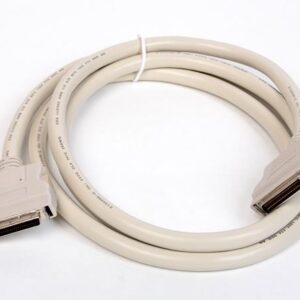
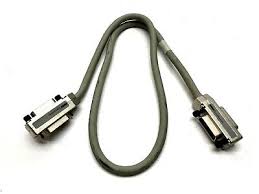
• GPIB connection: Shielded cables, Type X1 or X2
– Key Features
• IEEE 488.1 and 488.2 compliant
• Software transparent—existing applications require no modification
• Multiple extension topologies: linear or star configurations
• Buffered and unbuffered transfer modes
• Parallel poll support (immediate and latched modes)
• Integrated error-checking for data integrity
– Compatibility & Integration
GPIB-140B communicates with GPIB-140B and GPIB-140A only. GPIB-140B is not compatible with GPIB-140, GPIB-140/2, or GPIB-140A/2 due to protocol differences.







Reviews
There are no reviews yet.