

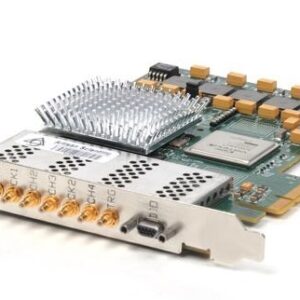
The NI PCI-4551 is a 2-channel dynamic signal acquisition board engineered for precision sound and vibration measurements. It delivers simultaneous 16-bit sampling at 204.8 kS/s across two analog input channels, with configurable gain ranging from -20 to +60 dB in 10 dB steps and input ranges from ±10 mV to ±42.4 V. The board includes two analog output channels sampled simultaneously at 51.2 kS/s with 16-bit resolution and output ranges of ±100 mV to ±10 V. Dynamic range reaches 90 dB. Both analog input and output paths incorporate anti-aliasing and anti-imaging filters with automatic cutoff frequency adjustment on the input stage. Eight digital I/O lines (5V TTL/CMOS) provide timing and control flexibility. The board supports AC/DC coupling and differential or single-ended input configurations. Analog and digital triggering—including external digital trigger and RTSI-based multi-device synchronization—enable synchronized acquisition across instrument clusters. PCI Local Bus Specification Revision 2.0 compatibility ensures broad system integration. Software-selectable parameters span bus addressing, interrupt channels, input modes, polarity, and gain settings. The 4.19 × 12.28 × 0.73 in form factor fits standard PCI slots. Compatible with NI-DAQ drivers, LabVIEW, LabWindows/CVI, ComponentWorks, VirtualBench, and Measure software. The BNC-2140 connector block is required for signal interfacing.
– Technical Specifications
• Analog inputs: 2 channels, simultaneously sampled at 204.8 kS/s, 16-bit resolution
• Input range: ±10 mV to ±42.4 V (software-selectable)
• Programmable gain amplifier: -20 to +60 dB in 10 dB steps
• Input coupling: AC or DC
• Input configuration: Differential or single-ended
• Analog outputs: 2 channels, simultaneously updated at 51.2 kS/s, 16-bit resolution
• Output range: ±100 mV to ±10 V
• Dynamic range: 90 dB
• Digital I/O: 8 lines, 5V TTL/CMOS
• Analog and digital anti-aliasing and anti-imaging filters with automatic input cutoff adjustment
• Triggering: Analog, digital, and external digital; RTSI multi-device synchronization
– Key Features
• Simultaneous dual-channel acquisition eliminates phase skew between channels
• Wide input dynamic range accommodates low-level transducers and line-level signals
• Configurable coupling and input modes adapt to varied sensor requirements
• External triggering and RTSI synchronization enable multi-board test systems
• PCI Local Bus Specification Revision 2.0 compliance
– Typical Applications
• Sound and vibration measurements
• Audio signal processing and analysis
• Acoustics and speech research
• Sonar applications
• Audio frequency test and measurement
• Vibration and modal analysis
• Automotive NVH analysis
– Compatibility & Integration
• PCI Local Bus Specification Revision 2.0
• NI-DAQ driver, LabVIEW, LabWindows/CVI, ComponentWorks, VirtualBench, and Measure
• RTSI bus for multi-device synchronization
• Requires BNC-2140 connector block; SHC50-68 digital cable, RTSI cables, and 68-pin shielded connector accessories available








Reviews
There are no reviews yet.