

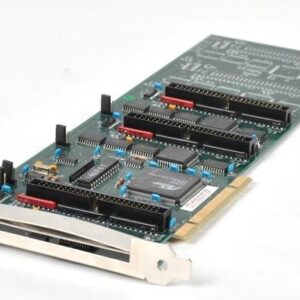
The NI PCI-6503 is a 24-line digital input/output card for PCI bus computers, delivering bidirectional DIO capability across 24 channels with flexible operating modes. Built around the 82C55A programmable peripheral interface chip, the card supports unidirectional, bidirectional, and 2-wire handshaking configurations. It operates at 5 V TTL/CMOS logic levels and requires no jumper or switch configuration—automatic resource allocation and Plug and Play compatibility eliminate manual setup. The 50-pin ribbon-cable connector interfaces directly to host systems, with integrated support for interrupt requests, change notification, and pattern matching across all digital lines.
– Technical Specifications
• Channels: 24 bidirectional DIO lines organized as three 8-bit ports (A, B, C)
• Logic Levels: 5 V TTL/CMOS; input 2.2 V to 5.3 V (high), −0.3 V to 0.8 V (low)
• Output Current: 2.4 mA typical
• Power Requirement: 400 mA at +5 VDC (±5%); power available at I/O connector +4.65 V to +5.25 V
• Bus Interface: PCI, 5 V PCI slot recommended
• Connector: 50-pin male ribbon-cable
• Operating Temperature: 0 °C to 55 °C
• Storage Temperature: −20 °C to 70 °C
• Dimensions: 4.8 × 3.7 inches
• Weight: 1.9 oz
– Key Features
• Completely jumpless configuration with automatic resource allocation at startup
• Three operating modes: unidirectional, bidirectional, and handshaking (2-wire)
• User-definable power-up state (high or low) with selectable jumper per line
• 100 kΩ pull-up resistors on each I/O line
• Interrupt capability for event-driven applications
• Pattern matching and change notification supported
• +5 V power supply output available via Pin 49
– Typical Applications
Industrial automation, laboratory instrumentation, and automated test environments requiring cost-effective PC-based digital control and data acquisition.
– Compatibility & Integration
Supports Windows 2000/NT/XP with NI-DAQ 7 driver software. Compatible with LabVIEW, LabWindows/CVI, Measurement Studio, and standard programming languages including Visual Basic, C/C++, and C#.









Reviews
There are no reviews yet.